Get AI Briefings, Transcripts & Alerts on Local & National Government Meetings — Forever.
Valley County planning commission seeks agency input, timeline for Red Ridge Village PUD review
Loading...
Summary
At a March 31 work session, the Valley County Planning and Zoning Commission heard legal guidance on mitigation authority, directed the applicant to secure technical studies and agency responses, and set May and June work sessions to assess whether impacts (roads, water, fire, schools) can be mitigated before any concept recommendation.
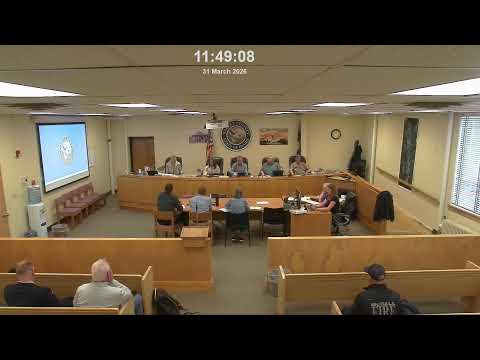
The Valley County Planning and Zoning Commission held a special work session on March 31 to review the Red Ridge Village Planned Unit Development (PUD) concept and to set a process for agency review and fiscal analysis.
County prosecutor Brian Oke told commissioners the Local Land Use Planning Act (LUPA) and related Idaho code (cited in materials as sections 67-65-12 and 67-65-13) authorize the commission to require studies — social, economic, fiscal, environmental and aviation — when evidence is needed to support mitigation conditions. "The statute outlines your grant of authority to require conditions of approval," Oke said, adding that any mitigation must show a clear nexus to impacts the proposed development would cause and be supportable in the administrative record.
Why it matters: the commission must decide whether the Red Ridge concept is a compatible land use and, if so, what hazards or impacts must be mitigated before recommending the PUD to the Board of County Commissioners. Commissioners repeatedly cited roads, water quantity and quality, fire/EMS capacity, school impacts and wastewater as primary areas where technical evidence is needed.
Applicant Christine Richmond of GSBS Architects told the commission the project team has begun work on wildfire interface mapping and wildlife/open-space plans and has met with Idaho Fish and Game. "We want to make sure that, as we go through, that we're scoping that any economic or fiscal impact analysis ... so that it actually answers the questions that you have," Richmond said, and asked the commission to be specific about which agencies and issues the studies should address.
Commissioners and staff compiled a broad referral list for the applicant to contact: McCall Fire and EMS, local law enforcement, Northlake Sewer & Water, the City of McCall, Cascade schools (and other school districts affected by employee housing), Idaho Department of Environmental Quality (DEQ), Idaho Department of Water Resources (IDWR), U.S. Army Corps of Engineers (for wetlands), Idaho Fish and Game, Idaho Department of Lands, Idaho Power, Valley County trails groups and snowmobile organizations, and neighboring Adams County. Several participants noted some state agencies will only offer substantive comment after receiving numerical engineering data.
A proposed density figure surfaced during discussion: commissioners referenced the applicant's current concept of about 776 units and debated whether density should be part of a concept-level decision or reserved for later entitlement stages.
Economic and fiscal study: commissioners recalled previous analyses used for large Valley County PUDs (examples cited: WestRock/Tamarack) and a property-tax summary noting Tamarack generated roughly $30,000,000 in property taxes from 2002–2023. The commission agreed it needs a fiscal-impact report scoped to the county and school/district questions; the applicant said a study could be completed in roughly six to eight weeks once scoped.
Schedule and next steps: the commission set a May 21, 2026, 9:00 a.m. work session to invite agencies to respond to a focused question: Can impacts of the proposed application be mitigated (yes/no) and, if not, what would be a deal-breaker? The commission targeted June 25, 2026, at 9:00 a.m. to review the economic/fiscal impact analysis and to hold a subsequent public hearing after agencies and the fiscal study provide more information. Commissioners also arranged a special meeting in April to form a small committee and recommend to the Board of County Commissioners a consultant (or list of firms) to perform the fiscal study.
Votes at a glance: the only formal vote on the record at this session was approval of the minutes from Feb. 25, 2026. Planning staff and the applicant left with a clear assignment: the applicant will meet with listed agencies, refine scopes for technical studies (traffic, water, fire/EMS, sewer), and return with agency input and the fiscal analysis for commission review.
The commission adjourned the work session after setting the schedule and assignments.