Get AI Briefings, Transcripts & Alerts on Local & National Government Meetings — Forever.
Senate committee hears fierce debate over bill to curb commissioner-issued arrest warrants
Summary
A contentious hearing on House Bill 336 focused on proposals to require prosecutor review before district court commissioners can trigger arrest warrants on single civilian complaints; prosecutors and public defenders backed reform citing dismissal rates, while the judiciary and victim advocates warned of delays and risks to victim safety.
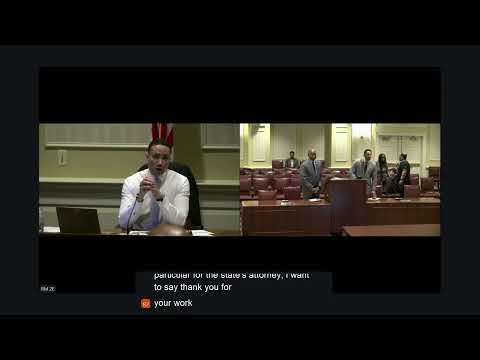
Delegate Jackie T. Addison urged the Judicial Proceedings Committee to back House Bill 3-36, calling it a bipartisan due-process measure to stop arrest warrants from being issued based solely on an unverified private complaint. "True probable cause of arrest shall be the stepping stone of our criminal justice system, not an unverified statement," the sponsor said as she described the bill's aim to allow summonses while reserving warrants for cases reviewed by prosecutors and judges.
Baltimore City State's Attorney Ivan Bates told the committee his office supports the bill and cited local data: "In 2025, there were approximately 290 total cases that individuals received in terms of going to the court commissioner. Of that 290, 112 of them were issued warrants," he said, adding that many of those matters were later dismissed or resulted in no guilty finding. Bates said the proposal seeks to reduce wrongful arrests and the downstream harm to individuals and the system.
Brian Levy, a supervising attorney at the Baltimore City Public Defender's Office, echoed prosecutors' concerns. "This is a bill where the office of the public defender and the state's attorney's offices in this state agree," he said, arguing commissioners lack the capacity to investigate allegations and that the current system invites abuse by people seeking revenge or to gain tactical advantage.
Judge John Morrissey, chief judge of the District Court of Maryland, urged caution and an unfavorable report on the bill as drafted. He said commissioners are trained, staffed and available 24/7 and warned the bill as amended "blurs these boundaries in ways that jeopardize judicial independence and ignore public safety." Morrissey and other judiciary witnesses raised operational concerns about shifting warrant decision-making to prosecutors and judges, duplicative service of process, and potential delays in time-sensitive cases.
Victims' advocates also opposed the bill's present form. Dorothy Lenny, executive director of GOCAP, said proponents cite dismissal rates without distinguishing between malicious filings and victims who later fail to return to court because of fear, lack of childcare, work or transportation. She warned that removing or weakening the commissioner pathway could strip vulnerable victims of a critical access point to the courts and urged thorough data and stakeholder work before sweeping change.
Committee members pressed witnesses on statistics, the possible removal of a 72-hour statutory review deadline that prosecutors and the AG's office flagged as problematic, and practical alternatives such as enhanced screening, better coordination for weekend or after-hours review, or a focused study. Several senators urged either immediate amendments to address operational problems or a stakeholder-driven study with the judiciary, prosecutors, public defenders and victim advocates to craft workable reforms.
The committee did not take a final vote; members discussed amendments and next steps, including further drafting and potential study, before moving on to other bills.