Get Full Government Meeting Transcripts, Videos, & Alerts Forever!
Get email alerts on the Produced Water topic
No spam. Unsubscribe anytime.
Committee asks LSO to draft bill giving OGCC authority over commercial produced-water transfers
Summary
The Minerals, Business & Economic Development Committee unanimously asked the Legislative Service Office to draft legislation clarifying the Oil and Gas Conservation Commission's authority over commercial produced-water retention ponds, pipelines and custody transfers so the industry can expand reuse while assigning custody liability at permit-defined transfer points.
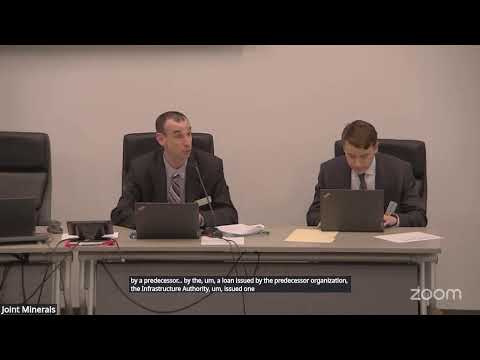
Tom Kopach, supervisor at the Wyoming Oil and Gas Conservation Commission, told the committee produced water — water produced in association with oil and gas operations — is already regulated by the commission in noncommercial contexts but that statutory gaps prevent clear permitting of commercial transfers and midstream water companies. "The commission has authority to regulate the location, construction, operation and reclamation of produced water retention pits," Kopach said, describing proposed statutory language to add commercial retention ponds, pipelines and transfers to that authority.
The request comes after Kopach outlined technical and economic benefits of reuse within the industry, including reduced freshwater use for hydraulic fracturing, smaller disposal volumes and lower operating costs. He estimated Wyoming produces "a little over 1,000,000,000 barrels of water per year," with large shares from the Bighorn Basin and extensive recycling in some EOR operations.
Committee members pressed Kopach on liability and custody-transfer points. Senator Roffus asked whether new statute would be needed to allocate liability when water changes hands. Kopach said a custody-transfer point could be identified in a permit and that the permitting language he proposed could define where liability transfers to the operator of the receiving infrastructure.
Pete Obermueller of the Petroleum Association of Wyoming spoke during public comment and explicitly supported Kopach's proposal, calling the LSO drafting request a tool to create the regulatory framework industry needs to cooperate. Jennifer Zingman, water quality administrator at the Department of Environmental Quality, confirmed DEQ's continuing role for commercial oilfield waste disposal facilities and described current record-keeping requirements for transfers; she said DEQ would coordinate with OGCC mapping permitting jurisdiction on a case-by-case basis.
After the presentation and public comment, Co-chair Anderson moved that the committee ask LSO to draft the statutory changes Kopach recommended; Representative Lawley seconded. The committee recorded unanimous approval and directed LSO to prepare bill language for consideration at the committee's next meeting.
The committee did not adopt final statutory text today; the motion asked staff to draft language that would permit the commission to regulate produced-water retention pits, pipelines and other infrastructure used solely for storage, transport and treatment of produced water and explicitly allow transfers for oil-and-gas exploration and production reuse while preserving applicable DEQ and state-engineer roles where surface discharge or appropriation is involved.
Next steps: LSO will prepare draft language for the committee; staff and agencies indicated they will coordinate to clarify custody-transfer points and reporting requirements before the draft is finalized.