Get Full Government Meeting Transcripts, Videos, & Alerts Forever!
Get email alerts on the Private Roads topic
No spam. Unsubscribe anytime.
Brookfield select board opens review of private‑road rules after state RSA changes
Summary
At a April 27 working session, the Brookfield select board reviewed local definitions and state guidance for private and Class 6 roads (RSA 674:41), emphasized emergency‑access and maintenance agreement requirements, and directed staff to compile a list of private/accepted private roads and consult town departments and neighboring towns.
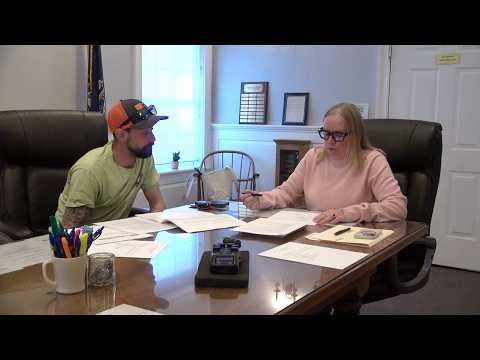
Brookfield select board members held a working session on April 27, 2026, to review how the town should define and regulate private roads and to consider the practical effects of recent changes in state law.
The board focused on two related issues: clarifying local definitions for "private road" versus Class 6 roads and determining what the town can and should require for new construction and building permits. Select Board member B opened the meeting, noting it was "the first time sitting down together with . . . perspectives on this issue, which is private roads." Chair said the meeting was called to order at about 5:02 p.m.
Why it matters: recent state action and RSA 674:41 require towns to issue building permits on Class 6 and private roads when applicants file waivers that release the town from liability, but the statute and accompanying guidance do not prescribe construction standards. That creates a gap the board wants to fill locally while protecting taxpayers from assuming maintenance costs.
Board members read aloud and compared definitions. Select Board member B read the planning‑board/zoning definition that a private road is "not open to public use as a matter of right," that maintenance is "borne by the . . . landowners or the association of abutting land owners," and that it "serves 3 or more lots." The board also reviewed a broader town definition that framed a private (or "bridle") road as one not accepted by the town "as a public highway" and "not maintained at public expense."
Members repeatedly flagged public‑safety questions. Select Board member D warned that many private roads and some Class 6 roads lack turnarounds and year‑round access for emergency vehicles, saying that an ambulance or fire truck ‘‘cannot get up’’ certain roads. The board discussed requiring clear turnarounds, culverts, minimum widths, and gravel bases for any new private road tied to a building permit.
Board members also discussed how existing private roads should be treated. Select Board member D pointed to a statutory exemption (transcript reference to a "section e") that can protect an "existing street constructed prior to the effective date" from having to be upgraded when new construction occurs, meaning long‑established roads with multiple houses may be grandfathered from modern standards.
Legal and mortgage implications were another focus. Select Board member D and others noted that waivers must be recorded at the Carroll County registry of deeds and that more recent state law steps were intended to solve mortgage‑lending problems on private roads by requiring a road maintenance agreement for properties on such roads. The board reviewed a draft road‑maintenance agreement that includes cost sharing, dispute resolution, preservation funds, and a requirement that the agreement be referenced in future deeds.
Inventory and next steps: members began naming roads they believe are private or accepted private in Brookfield (Kait Lane, Pinkham, Camp Road, Kimball Mill Road, Henshaw Road, Kingswood Lane, Anna Lane, Woodman Hill and others that cross into Wakefield). The board asked staff to locate an older road‑committee survey (circa 2008), compile a comprehensive list of private and accepted private roads, and bring model ordinances from towns such as Canterbury and Madison for comparison. They also directed staff to consult the road agent, planning board, fire chief and police chief before drafting any local ordinance or policy.
What the board did not do: the meeting was informational and procedural; the board made no formal motion, did not adopt any ordinance, and took no vote. Instead, it assigned research and document retrieval tasks to staff and agreed to return with a tighter set of proposed definitions and potential ordinance language.
Representative quotes
"This is a working session . . . which is private roads," Select Board member B said at the start of the meeting. "We should get a full little list."
"An emergency vehicle cannot get up," Select Board member D said, arguing the town must consider access and turnarounds for safety.
"No building permit shall be issued unless compliant with RSA 674:41," Select Board member B said while summarizing statutory constraints and the town's obligation to clarify definitions for the public.
Next steps and timeline: staff will locate the 2008 road‑committee survey and compile a confirmed list of private and accepted private roads, gather the RSA 674:41 text and the earlier 1986 waiver policy for review, and provide model ordinances and draft maintenance‑agreement language. The board set those items as the basis for the next discussion; no ordinance or formal regulatory action was scheduled at the meeting's close.
Ending: The board adjourned at about 5:51 p.m. after agreeing to circulate documents and follow up with town departments and neighboring‑town examples.