Get AI Briefings, Transcripts & Alerts on Local & National Government Meetings — Forever.
San Patricio County court backs regional water‑management resolution after residents warn of 'water wars'
Loading...
Summary
Commissioners approved a resolution supporting regional coordination on water management April 27 after residents and a visiting geologist warned that large‑scale pumping and proposed well projects could harm shallow wells and mobilize arsenic; the resolution will be sent to neighboring Goliad County and Austin.
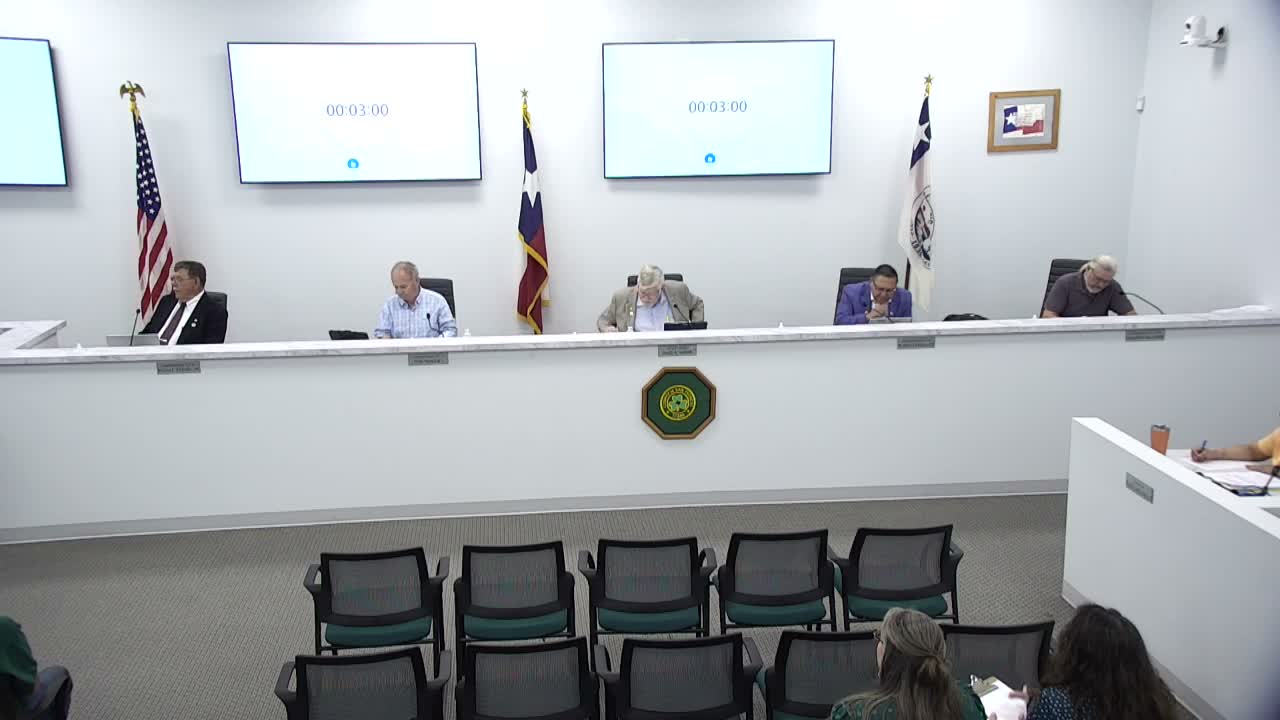
San Patricio County Commissioners Court on April 27 approved a joint resolution supporting regional coordination and sustainable water management after residents and an expert warned that large‑scale groundwater pumping and proposed projects risk damaging local shallow wells.
The resolution, introduced by County Judge David Krebs and approved after a motion by Commissioner Gillespie and a second from Commissioner Yardley, directs county leadership to pursue coordinated regional responses to the South Texas water supply concerns and will be signed and forwarded to Goliad County Judge Mike Bennett and the governor’s office in Austin, Krebs said.
Residents used the 'Citizens to be heard' portion to press the court on groundwater risks. Sonia Witherspoon (Precinct 3) described plans for a community water‑rights fair and citizen well testing, outlining logistics for drop‑off testing (Wednesday drop‑off 07:30–11:00; Thursday fair sessions 9:00–noon, 1:00–4:00 and 6:00–8:00), a $15 county test option and an $85 expedited laboratory option via Texas A&M, and said the Farm Bureau will host the event. Witherspoon said the fair will include classroom sessions and a baseline database for private wells.
Veil Dawkins, a Bee County resident and ranch owner, told commissioners: "This is what people are starting to call water wars here in South Texas," urging elected officials to prioritize residents on shallow wells and to use their influence to protect local water supplies.
The court then heard an in‑depth presentation from Bill Formley, a petroleum geologist and hydrologist introduced by the judge as a former Staunton resident, who mapped regional formations and described how production from deeper formations can affect shallower drinking water supplies. Formley warned that numerous perforations in well screens and large‑scale pumping can mobilize saltwater and arsenic upward, changing salinity and quality for wells that tap the Chico and Evangeline aquifers. "The EPA allowable is 10 parts per billion," Formley said in discussing arsenic and urged more frequent, certified testing than what some systems currently perform.
Formley displayed a map he said shows a proposed 25‑well development and argued such a project could "destroy every bit of the aquifer here" for shallow users. He also urged the court to consider prohibiting uranium mining in the county and asked local groundwater conservation authorities to assert no‑export positions where available, citing Goliad County precedent.
As a mitigation option, Formley recommended exploring reverse‑osmosis and containerized desalination (he referenced Puronics systems), describing examples of treatment scales (containerized units in the hundreds of thousands to a million gallons per day, and larger floating plants at higher scale) and a company guarantee of membrane lifetimes of roughly 30 years. He suggested county leaders pursue state funding and emergency orders to support pilot treatment capacity and relieve pressure on local aquifers.
Commissioners did not adopt specific permitting conditions during the meeting; instead the court’s formal action was the unanimously approved resolution endorsing regional coordination and sustainability measures. Judge Krebs said the signed resolution will be forwarded to Goliad County and the governor’s office for broader regional consideration.
The next procedural step noted at the meeting was sending the resolution to neighboring leadership and to the governor’s office; county officials did not announce additional immediate regulatory changes or a formal groundwater moratorium at the April 27 session.