Get AI Briefings, Transcripts & Alerts on Local & National Government Meetings — Forever.
Committee hears bill to let more Missouri library districts ask voters for a sales tax
Summary
Sen. Justin Brown presented Senate Bill 10 23 to the Committee on Local Government, which would let 29 libraries in 42 counties seek voter approval of a local sales tax; the bill includes a Saint Charles County rollback provision, lower caps for Cass and Johnson Counties, and a $15 civil-surcharge option for law libraries. Library directors testified in favor and the committee plans to executive session the bill Monday.
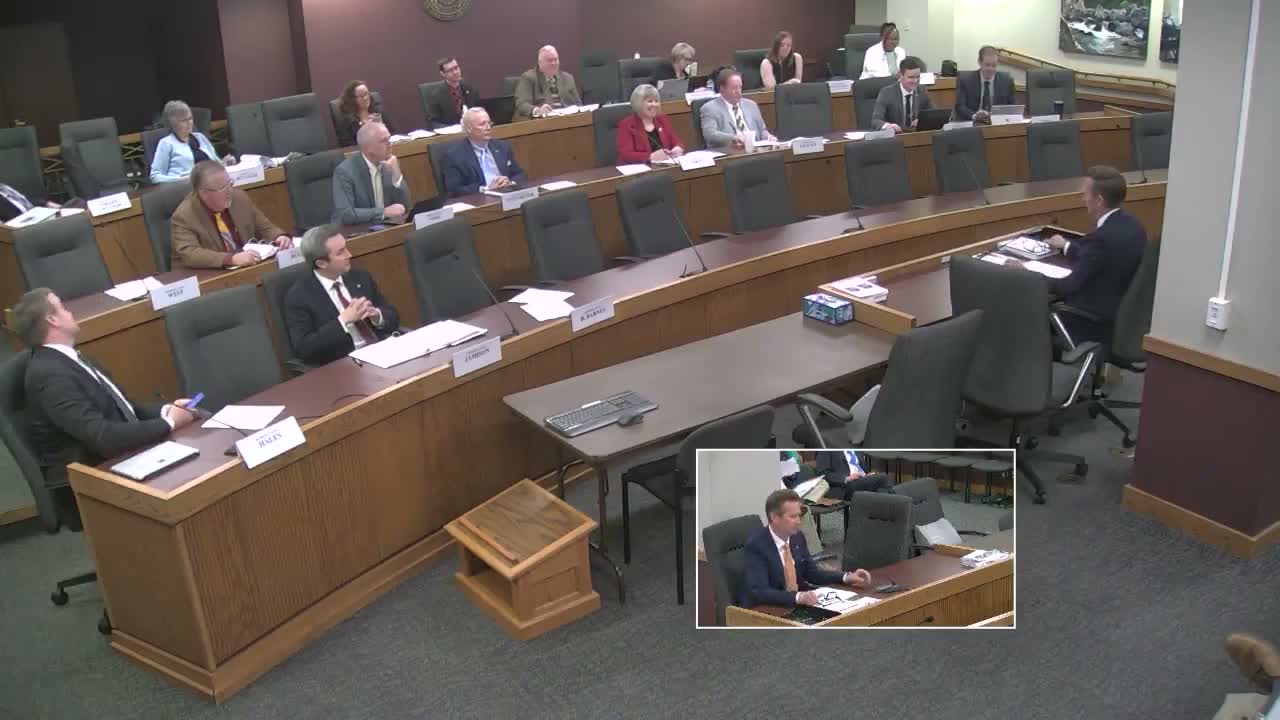
At a public hearing of the Committee on Local Government, Sen. Justin Brown, R‑16th District, introduced Senate Bill 10 23, saying it would expand authority for more Missouri public library districts to ask voters to impose a local sales tax.
"Current law authorizes public library districts for a few counties to impose a sales tax up to a half a percent," Sen. Brown said. He summarized amendments that require Saint Charles County library property levies to be reduced to offset 100% of new sales-tax revenue, cap the rate for Cass and Johnson counties at 0.33%, and allow a civil-case filing surcharge of up to $15 to maintain law libraries.
The bill would add 29 public libraries in 42 counties to the existing statute that currently applies to a small number of districts, witnesses said. Steve Campbell, director of the Scenic Regional Library, told the committee the measure merely gives libraries the option to put a sales-tax question before local voters: "It only allows individual public libraries the option to ask voters to approve a sales tax," Campbell said, noting Poplar Bluff’s earlier decision to replace its property tax with a sales tax.
John Griese, CEO of the Saint Charles City County Library, described the Saint Charles amendment’s transition mechanics and local needs. Under that amendment, if Saint Charles imposes a sales tax the district would roll back property taxes dollar for dollar and use a three‑year phase‑out to transition funding. Griese said the change would let the library engage voters about building two new branches and other service priorities: "This bill provides us that opportunity to have that discussion and then go to the voters," he said, and estimated an equivalent sales tax for Saint Charles would be about one‑half cent.
Some committee members pressed on equity and mechanics. Representative Voss asked whether a sales tax would make nonresidents who do not use a library nonetheless pay for it; Griese said the district charges nonresident fees today but acknowledged the interaction between nonresident fees and a county‑wide sales tax would need to be worked out.
Witnesses emphasized the bill responds to broader debate about property‑tax reform. Matt Raynor, director of the Marshall Public Library, said voters in his county approved a quarter‑cent sales tax in November 2024 and warned that unrelated litigation over county classification could retroactively threaten such voter‑approved taxes; he said SB 10 23 includes provisions intended to protect those votes. Randy Sher of the Missouri Library Association called the package a "safety net" for many libraries that signed on amid recent property‑tax reform discussions. Chris Ropey of the Kansas City Public Library highlighted a narrower provision (cited in testimony as section 182.711) that would offer discretionary fiscal‑year scheduling flexibility to the Kansas City Public Library.
No committee vote took place at the hearing. The chair closed public testimony and said staff plans to put SB 10 23 on the committee’s executive calendar for Monday at noon; members will receive email confirmation. The hearing record includes testimony from multiple library directors and organizational representatives and several committee members who voiced support.