Get AI Briefings, Transcripts & Alerts on Local & National Government Meetings — Forever.
House committee advances Welcoming Alaska office bill after amendments on staffing and services
Summary
The House State Affairs Committee adopted multiple amendments to HB 188 to split refugee and welcoming‑office director roles, add support for newcomer business formation, clarify service coordination (not direct provision) and remove the word 'new' from 'immigrant'; the committee passed the committee substitute as amended and moved it forward with attached fiscal notes.
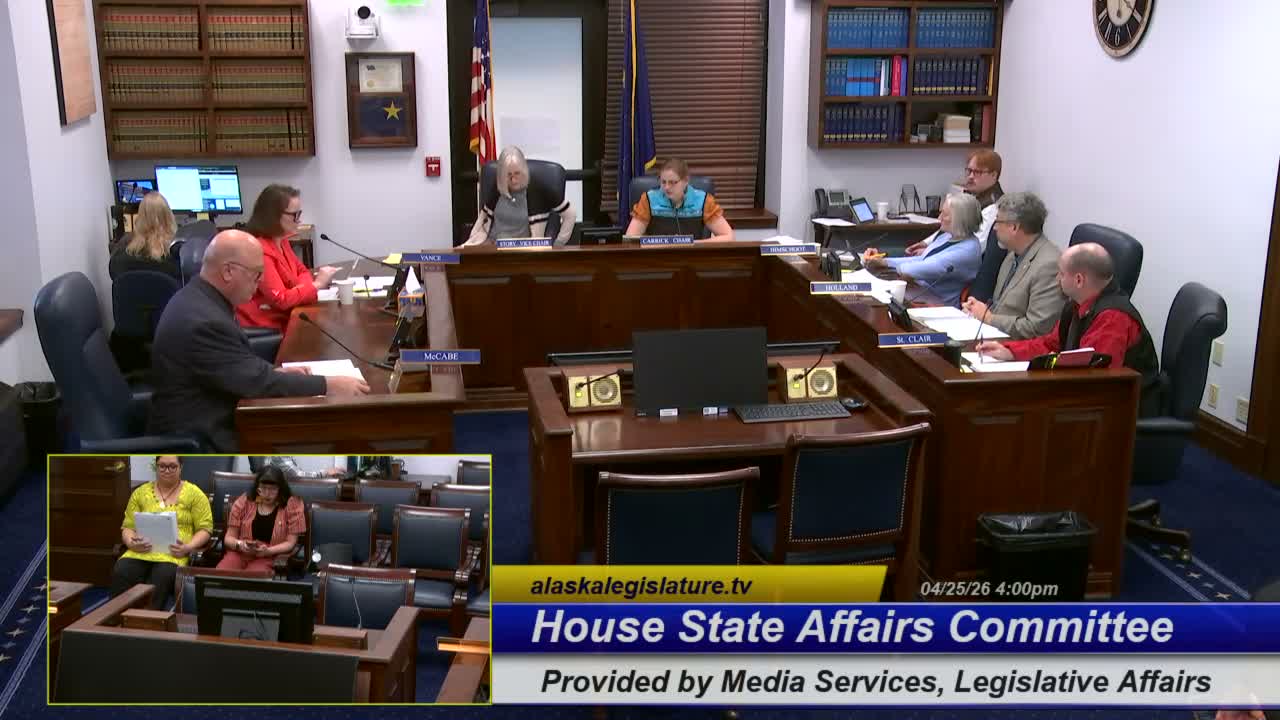
The House State Affairs Committee on April 25 adopted a set of amendments and voted to move a committee substitute for House Bill 188 (the Welcoming Alaska office) out of committee after debate over staffing, program scope and fiscal notes.
Representative Genevieve Mina, sponsor of HB 188, told the committee the bill creates a Welcoming Alaska office and an Alaska Office of Refugees; Amendment 1 separates the director positions so the refugees director can be funded through federal refugee resettlement dollars, while the Welcoming Alaska director would be a state appointment.
"When we created the committee substitute, our intent was for the director of the welcoming Alaska office and the director of the Alaska office of refugees to be separate positions," Mina said, and she described how federal funding constraints make separation useful for administration and federal reimbursement.
Amendment 2, moved by Representative Holland and accepted as friendly, expanded the office's duties to include removing licensing and other barriers for newcomers to start businesses and to develop strategies to support scaling those businesses; it also added a business‑and‑economic‑development perspective to the advisory committee. Holland cited research showing immigrants are more likely than the general population to start new businesses.
Representative Himchute offered a conceptual amendment (amendment 4, also called I.5) to remove the word "new" before "immigrant" and to broaden language instruction language to focus on career‑specific and coordinated services rather than the office directly providing all services. Sponsor and committee members said removing "new" makes the bill more inclusive and reduces the risk of violating federal nondiscrimination requirements.
The committee debated fiscal questions and compliance with equal‑opportunity statutes. Representative Sinclair raised concerns about the fiscal note, noting Catholic Social Services had received an $846,000 grant in 2025 and that 42 refugees were resettled in Anchorage that year; Mina said much of the work would be federal‑funded and she is open to working with the next committee on fiscal adjustments.
Vice Chair Story moved the committee substitute for HB 188 as amended, with attached fiscal notes and authority for legal staff to make technical changes. After discussion and the removal of objections, the committee passed the bill from committee as amended and signed the committee paperwork for referral.
The bill will go to the next committee of referral for further fiscal and legal review and any additional adjustments.