Get Full Government Meeting Transcripts, Videos, & Alerts Forever!
Get email alerts on the Infrastructure Bridges topic
No spam. Unsubscribe anytime.
Community Board 11 hears NYSDOT plan for Bronx River Parkway bridges and gated NYPD access
Summary
Community Board 11 members and Parks Department representatives described NYSDOT contract D900059 to replace two Bronx River Parkway bridges and add a gated NYPD access ramp intended to improve safety, reduce environmental impact and minimize tree loss; Parks said the design-build approach will move quickly into construction as subprojects are finalized.
Debbie Clark, cochair of Community Board 11’s Parks, Recreation, Sanitation & Environmental Protection Committee, opened an update on New York State Department of Transportation contract D900059, a design-build project to replace two bridges on the Bronx River Parkway between East Tremont Avenue and Bronx Park and to add a controlled NYPD entrance.
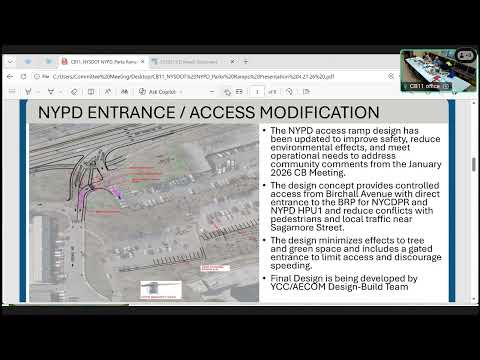
"The NYPD access ramp design has been updated to improve safety, reduce environmental effects, and meet operational needs to address community comments from the January 2026 CB meeting," Debbie Clark said, describing a concept that includes a gated entrance, a new pedestrian ramp and crosswalks and an expansion of parking by 12 spaces.
Matt, a Parks Department representative who participated in design reviews, said Parks worked with NYSDOT and other city divisions on multiple iterations and settled on what he called the least-invasive option. "We had three agencies collectively looking at this…to see what was the most effective and least invasive way," he said, adding that the design-build delivery means elements move from design directly into construction as they are completed.
Parks officials described a staggered shared-use path intended to slow cyclists where the greenway meets roadway crossings; signage and short detours are planned to minimize user conflicts. The design team identified on the call included YCC and AECOM as the design-build team.
Committee members pressed Parks for specifics about trees. A board member asked how many trees would be removed and how replacements would be handled under the local tree-restoration law; Parks said Forestry would need to provide exact counts and that tree-replacement rules are being followed. Matt and Charles, both described as Parks representatives, said the current plan reduces the number of trees affected compared with an earlier proposal that would have taken more parking and prompted community concern.
Diana Finch, a board member, asked how the greenway would be routed around a high stone wall in the Renauqua area; Parks representatives said routing details and any hardscape constraints would be clearer on a planned site walk-through. Parks also said temporary detours and signage would be used during construction to keep interruptions for greenway users as short as possible.
Because the meeting proceeded without quorum, the board did not take formal votes on the project; Parks staff invited follow-up questions and encouraged the board to contact Forestry for tree counts or to raise them on the scheduled walk-through. The committee did not set a formal schedule for construction milestones during the meeting.