Get AI Briefings, Transcripts & Alerts on Local & National Government Meetings — Forever.
Senate committee hears expert warn models must be reconciled before finalizing SB 280 tax framework
Summary
A Gaffney Klein consultant told the Alaska Senate Resources Committee that differing assumptions in midstream and upstream models make revenue forecasts for SB 280 unreliable, urging an auditable open-book project model and warning price caps and tax designs can materially affect project viability and consumer tariffs.
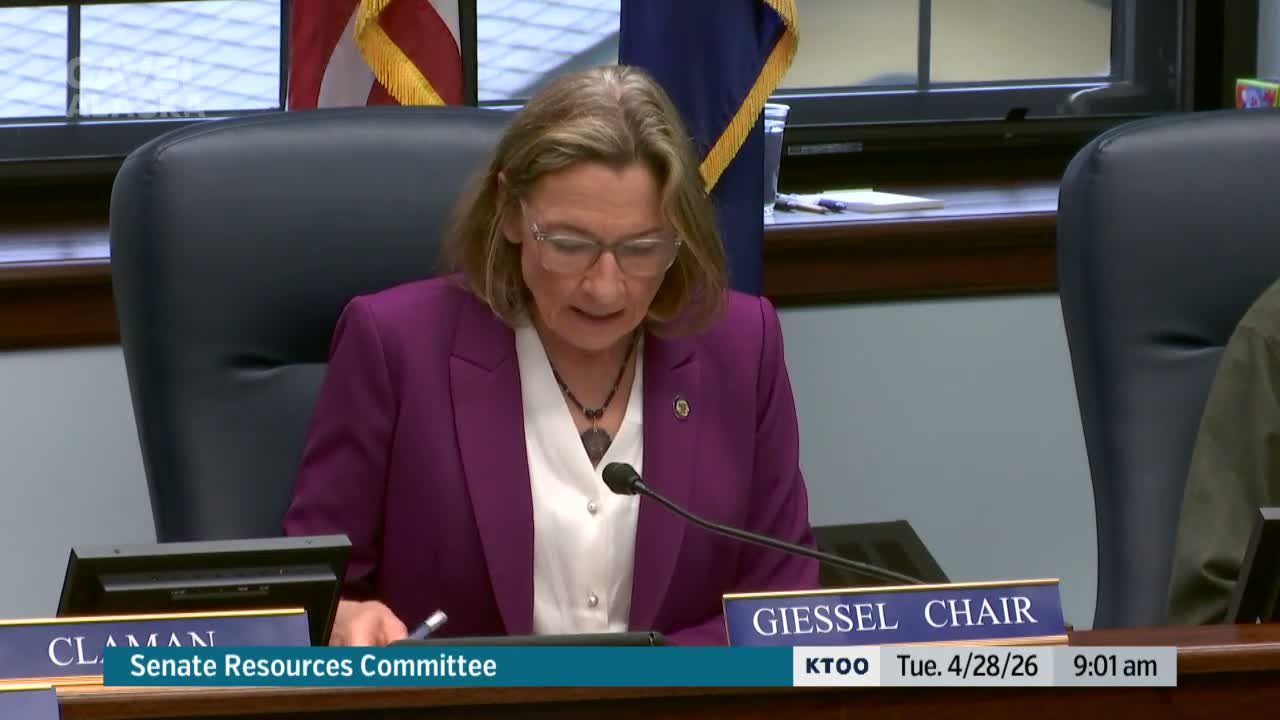
A consultant for the Legislature told the Senate Resources Committee on April 28 that lawmakers should reconcile competing project models before finalizing tax rules in Senate Bill 280, the bill that would change how oil and gas are taxed for a proposed Alaska LNG development.
Nick Fulford, senior director for gas, LNG and energy transition at consultancy Gaffney Klein Energy Advisory, said the numbers the committee has seen are “directional” but not yet audited. He recommended creating a standard open‑book economic model to align assumptions across midstream and upstream participants and government analysts.
Fulford told senators the model used for his testimony focused on midstream economics only and assumed a 70/30 debt‑to‑equity capital structure, a 5% cost of debt and a 10% return on equity. Using those assumptions, his slides showed corporate income tax receipts rising from roughly $157 million in year two of operations to nearly $900 million by 2050, and cumulative alternative volumetric tax (AVT) plus corporate tax receipts on the order of $20 billion over the project life. He warned, however, that those figures are sensitive to transfer pricing between producers and the midstream developer and to other inputs such as federal tax credits and CO2 removal costs.
Senators pressed Fulford on key assumptions. Vice‑Chair Senator Willikowski and others did back‑of‑envelope math that suggested outsized returns to developers under certain assumptions; Fulford acknowledged there appear to be inconsistencies between models and said he would reconcile numbers with the Department of Revenue and provide written clarifications. “I have concerns about the logic and the numbers coming together,” he said, urging a joint review of models.
Much of the committee’s questioning centered on tariffs for a proposed Phase‑1 pipeline and the effect of statutory price caps. Fulford’s analysis showed that, at a 10% project return, a 500 million standard cubic feet per day (scfd) throughput with a $10 billion pipeline capital cost could be consistent with a $12 per MMBtu cap, but that 300 million scfd flows would require tariffs in the $20–$30/MMBtu range to sustain comparable returns. He added that a $5 cap would substantially reduce consumer prices and could be transformative for South Central Alaska, but only under certain flow and financing scenarios.
Senators raised policy trade‑offs: higher early‑stage consumer subsidies or caps could derisk the pipeline up front but shift costs onto residents or the state while developers and producers seek long‑term commercial returns. Fulford suggested contractual and financing structures—including early supply commitments and blended finance instruments—could spread risk among customers, the pipeline developer and producers and help protect consumers during an initial revenue‑light period.
Committee members also asked whether specifying dollar caps publicly (the transcript notes the governor referenced a $12 cap) might discourage companies from sharing proprietary commercial information. Fulford said it could, because stakeholders interpret and use numbers differently; he recommended dialogue to craft subsidy or sharing mechanisms that permit confidential commercial engagement while meeting public policy goals.
Senator Myers asked about a community impact payment included in the bill; Fulford said modeling that $800 million payment is a next step and would raise the levelized cost of delivered gas. Multiple senators expressed urgency about reconciling models quickly: the session has about three weeks remaining and the committee wants a durable policy framework.
The committee did not take any formal votes during the session. The chair adjourned the meeting at 10:13 a.m. and scheduled a continuation of SB 280 testimony by the Department of Revenue for April 29 at 3:30 p.m.