Get AI Briefings, Transcripts & Alerts on Local & National Government Meetings — Forever.
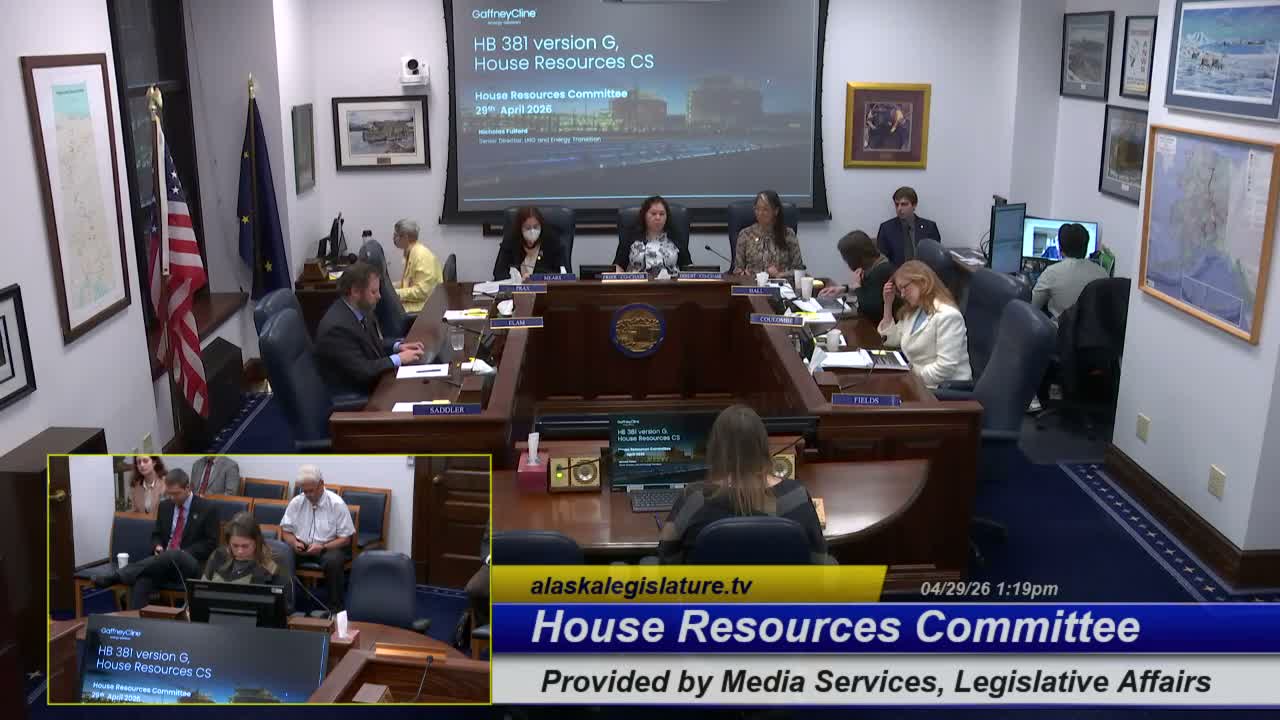
House Resources Committee hears fiscal and technical analysis of HB 3 81 for AKLNG
Loading...
Summary
Experts and agency economists told the House Resources Committee that an alternative volumetric tax (AVT) in House Bill 3 81 changes project economics, municipal revenue timing, and Fairbanks spur cost allocation; public testimony split between support and calls for more cost transparency.
Co-chair Representative Freer convened the House Resources Committee on April 29 to take expert and public testimony on House Bill 3 81, a proposal to substitute Alaska’s project property tax with an alternative volumetric tax (AVT) for the Alaska LNG (AKLNG) project.
Nick Fulford, senior director for LNG and energy transition at Gaffney Klein Energy Advisory, told the committee the bill’s AVT improves the project’s competitiveness by lowering the delivered cost of gas to Asian buyers compared with a property-tax structure. "Compared to the existing property tax arrangement, the AVT proposed in the committee substitute still generates around a 20¢ per MMBtu saving in terms of delivered cost to Asia," Fulford said, and he emphasized that “each step towards a profitable outcome for the project is key.”
Dan Stickel, chief economist at the Department of Revenue, presented departmental modeling that compared current law and the bill as introduced. Stickel said under current law municipal property-tax revenues from a full AKLNG build would begin in the "tens of millions" early in the project and could rise toward hundreds of millions per year as production ramps. He added that, under the bill as introduced, the AVT would only begin after a 1 billion cubic feet per day threshold and, in full-project scenarios, municipal receipts could ramp materially later in the project life. "The alternative volumetric tax would kick in beginning in 2031 once the project reaches the 1 BCF per day threshold," Stickel said; he also presented phase‑1 (in‑state only) scenarios that show smaller near‑term municipal revenues.
Committee members focused on three practical tradeoffs: (1) how tax design affects whether the AKLNG project is sufficiently competitive for global investors; (2) how the Fairbanks spur’s capital cost should be allocated among customers and whether the bill’s structure ensures municipalities will receive stable revenues; and (3) what forms of borough/community equity participation are feasible. Fulford described borough equity options through AGDC and noted complications when federal tax-credit structures (for example, in other projects) drive particular ownership arrangements.
Public testimony reflected divided views. A Wasilla resident testified in favor of HB 3 81, saying the bill phases taxation with production and makes Alaska more competitive; an Anchorage resident described pipeline-era local benefits and urged support; by contrast, Sean McDermott with the Fairbanks Climate Action Coalition urged the committee not to advance subsidy-like measures without detailed public cost estimates and community impact analysis.
The committee took no formal votes at the hearing and left public testimony open for additional comment. The bill was scheduled to return to the committee on May 1 alongside additional measures.
The hearing transcript and committee slide materials include detailed DOR spreadsheets and multiple modeling scenarios; the department offered to provide updated modeling after committee amendments are settled.