Get AI Briefings, Transcripts & Alerts on Local & National Government Meetings — Forever.
Health department outlines revised HHS funding priorities and three allocation scenarios
Summary
Teton County health officials presented changes to the joint town–county health and human services allocation process — including moving violence/abuse/neglect to top priority, removing housing from priority 1, and three quantitative funding scenarios — and called for a community needs assessment and governance review before finalizing awards.
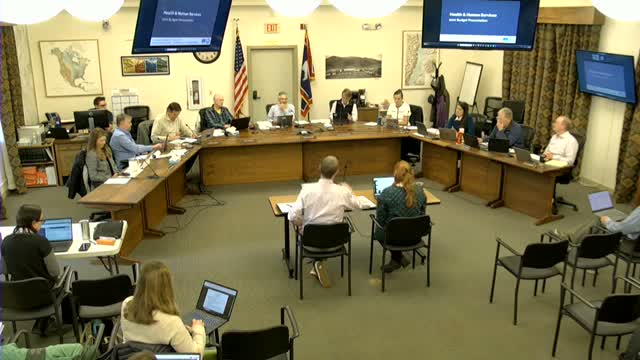
Dr. Riddell, director of the Teton County Health Department, told a joint county commission and Town of Jackson council meeting that the department has taken over administration of the county side of the county–town health and human services funding program and proposes several changes to how grant requests are prioritized and allocated.
The presentation traced the program to a 2017 systems-of-care map and a 2020 allocation plan that established priority categories and suggested proportional funding. “This is a program that has been in place for many years,” Dr. Riddell said, describing the map and the 2020 framework and noting that the department’s analysis shows existing spending patterns do not always match the plan’s priority buckets.
Why it matters: the department recommended shifting limited dollars toward the service areas the community has identified as most urgent. The key changes proposed this year are moving violence, abuse and neglect into priority 1 and removing housing from priority 1 (the latter because housing receives separate town and county support). The department also broadened outreach this year, posting applications publicly; that produced six new applicants for each jurisdiction.
Dr. Riddell presented three quantitative allocation scenarios as starting points for discussion. Scenario 1 would fully fund all applicants but would exceed last year’s allocation by roughly $200,000. Scenario 2 would repeat last year’s awards (flat funding). Scenario 3 — the staff-preferred “apply light prioritization” — would fund 100% of priority 1 requests, not fund new priority 2 and 3 requests, and reduce priority 2 and 3 funding for returning applicants (a uniform percentage cut in the quantitative model) to shift dollars into priority 1.
Commissioners asked how Scenario 3 affected individual organizations. “That is 5% from last year’s,” Dr. Riddell said when asked about a sample reduction, and he acknowledged that an even application of the rule produces larger proportional reductions for organizations that increased their requests this year. Commissioner Gardner pressed for protections and a clear rubric to help new organizations get a foothold; Dr. Riddell and other elected officials agreed new-entrant guidance and clearer expectations for applicants should be part of the next phase.
Several elected officials recommended pairing a formulaic budget target with a discretionary (non-programmatic) reserve to address emergent community needs such as immigration-related services. The mayor and several councilors suggested overlaying Scenario 3 on the town manager’s proposed budget and revisiting details at the town and county budget meetings in May.
Next steps: Dr. Riddell said the health department will conduct a community health needs assessment beginning this summer (report expected by 2027-06-30) and recommended revisiting the allocation priorities afterward. He also recommended exploring governance options, including forming a community board under the Wyoming Community Human Services Act or a block-grant model administered by an entity such as United Way, to separate technical allocations from elected bodies’ policymaking.
The bodies did not make final funding decisions in the session; staff asked commissioners and council members to review spreadsheets and return with preferences at upcoming May meetings and the joint meeting in June. County public comment is scheduled for May 18; town budget meetings are set for May 5 and May 13.
Ending: The presentation concluded with agreement to use the models as a starting point for discussion, to clarify applicant expectations (including how much of an organization’s operating budget typically is funded through this process), and to continue community engagement before final allocations are approved.