Get AI Briefings, Transcripts & Alerts on Local & National Government Meetings — Forever.
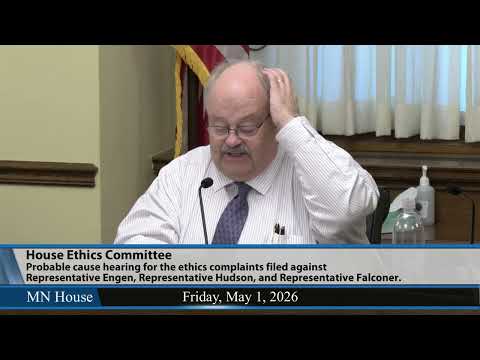
House Ethics Committee holds probable‑cause hearing on complaints that Reps. Engen and Hudson left committee to drink
Loading...
Summary
The House Ethics Committee heard complaints that Representatives Engen and Hudson left an Education Finance Committee meeting on March 26 to drink at a nearby bar, with complainants citing photographs and a social‑media post; Engen acknowledged remorse but denied dereliction of duty, and the committee did not record a probable‑cause finding in the transcript.
The House Ethics Committee convened a probable‑cause hearing to consider complaints that Representatives Elliot Engen and Walter Hudson left an Education Finance Committee meeting on March 26 to drink at a nearby bar during the legislative workday, complainant Leader Long said.
Leader Long told the committee he had photographic and video evidence showing the two lawmakers at a bar while the Education Finance Committee was still meeting and said that conduct "violates the rules of the education finance committee" and "brings the house into dishonor" under the House's ethics rules. He also cited press reporting that Representative Hudson holds a permit to carry and said the committee should consider whether the conduct could amount to a misdemeanor under Minnesota statute 624.7142 if a firearm was carried while impaired.
Representative Engen, who was designated a respondent, acknowledged personal remorse for events that night but disputed that he failed in his official duties. "I am holding myself accountable because I broke a set of standards that I hold myself to," Engen said, adding that he had "a single beer" at lunch, returned to the floor and later spoke for more than nine minutes. He told the committee he had missed no votes in that Education Finance Committee session and left briefly to use the restroom, charge his phone and get lunch.
Engen's counsel, attorney Chris Maddell of Maddell, P.A., urged the committee to consider the full record and said the complaint rested on photos of two people eating lunch. "That is entirely what your complaint is about," Maddell said, asking members to weigh whether the images and timestamps show impairment or a rule violation that merits discipline.
Members questioned whether leaving a committee while testimony continued, even when no votes were pending, violated committee rules requiring in‑person attendance. Several members emphasized that the committee's role is to weigh allegations narrowly; others said the photos and timing raised legitimate concerns about public trust and whether the conduct could have affected later votes taken that day on unrelated matters.
The transcript shows the committee approved minutes from April 28 at the start of the meeting, but it does not record a formal probable‑cause finding on either complaint. Committee members conducted extended questioning of Engen about the duration and purpose of his absence, the timing on video evidence, and institutional norms. No final disciplinary outcome was entered in the portions of the hearing captured in the transcript.
What happens next: Under the House Committee on Ethics rules described by the chair, if a majority of the whole committee finds sufficient factual evidence that the allegations are more probably true than not, the committee will inform the Speaker and members named that probable cause has been found and public hearings will follow; if the majority fails to find probable cause the complaint will be dismissed. The transcript does not record such a vote.
Authorities and actions cited in the hearing were drawn from the committee record and testimony, including the committee rule cited by the complainant and a reference to Minnesota statute 624.7142 as discussed during testimony. The committee adjourned without a probable‑cause determination recorded in the transcript.