Get Full Government Meeting Transcripts, Videos, & Alerts Forever!
Get email alerts on the Foreign Policy topic
No spam. Unsubscribe anytime.
Congressman says U.S. economic pressure is working as Iran faces oil storage crunch
Summary
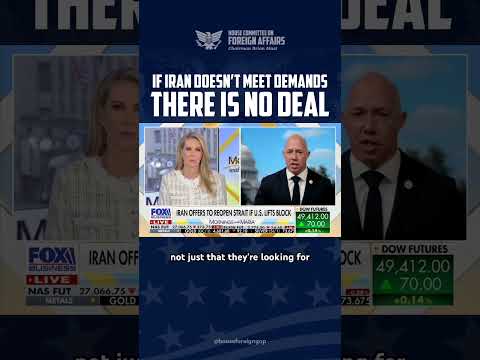
A congressman who chairs the House Committee on Foreign Affairs told a reporter that U.S. economic pressure on Iran "is absolutely working," while the reporter cited reporting that Iran could run out of oil storage within 12 to 22 days and warned of damage if production is shut down.
A congressman who serves as chair of the House Committee on Foreign Affairs said the U.S. economic blockade and other "maximum pressure" measures are "absolutely working," and reiterated that any settlement must prevent Iran from controlling passage through the Strait of Hormuz and halt its nuclear and ballistic missile programs.
The exchange began when a reporter summarized recent coverage saying the president was rejecting Iran's latest peace proposal over its lack of attention to Tehran's nuclear program, and cited reporting — described on air as from "the journal" and Kepler — that Iran could run out of oil storage within 12 to 22 days. The reporter used the terms "tank topping" and said some oil is being burned off because storage capacity is lacking.
"The economic blockade that the president very wisely put in place is absolutely working," said the congressman, adding that the United States will not accept less than what it needs in negotiations. He warned that while Iran "has an ability to intimidate the Straits Of Hormuz," it "does not have a total ability to close the Straits Of Hormuz," and listed two nonnegotiable items for talks: that Iran must not be allowed to use the strait as a tollway and that its nuclear and ballistic missile programs "have to come to an end."
In a follow-up, the reporter said the same agency reported that if Iran were forced to shut down production in some fields, roughly half of Iran's fields are low-pressure and shutting them could "destroy the oil" and corrode facilities. The reporter said that the 12–22 day window of storage pressure "could be, finally where we end up," framing that as a potential inflection point for Tehran's willingness to offer more concessions.
Neither the reporter nor the congressman provided independent on-the-record documentation in the exchange beyond citing news reports; the congressman attributed success to current U.S. pressure and emphasized negotiating red lines rather than offering details of next steps. No formal action, vote or committee proceeding was recorded in the transcript.
The broadcast exchange underscores how energy-market constraints and sanctions dynamics are being framed publicly as drivers of Iran's negotiating calculus. Further confirmation of storage estimates, field vulnerability and official U.S. policy moves would be required to determine whether the timeline cited by reporters will alter diplomatic outcomes.