Get Full Government Meeting Transcripts, Videos, & Alerts Forever!
Get email alerts on the Stormwater topic
No spam. Unsubscribe anytime.
Charleston council member and city staff outline $12.6 million stormwater project for South Windermere
Summary
Council member Ross Appel and city stormwater staff described a $12.6 million, phased project to add a new outfall, install larger pipes including two 48-inch storm drains, and reduce sunny-day flooding in South Windermere; officials said work will be staged on the Greenway, finish by 2027 and include vibration monitoring after residents raised foundation concerns.
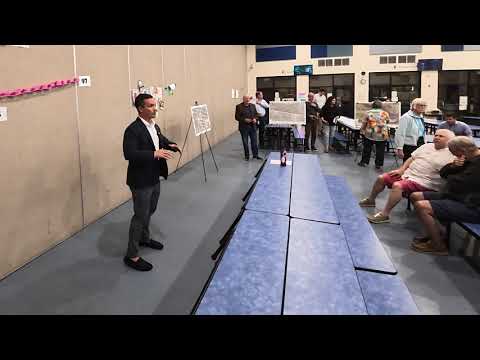
Council member Ross Appel announced a major stormwater upgrade for South Windermere, saying the project has been decades in the making and is “about a $12,600,000 project, funded both by city funding and also some state earmarks,” aimed at increasing drainage capacity and adding a new outfall behind the neighborhood school.
The plan, city staff said, will right-size undersized infrastructure identified in a 1984 Davis and Floyd report and add conveyance capacity to reduce flooding. “We are going to be substantially improving the capacity underneath Ackerman, with 2 new 48 inch stormwater pipes,” said Steve Kirk, project management practice lead for the stormwater department, who gave residents an overview of construction sequencing and impacts.
Why it matters: the project targets low-lying parts of West Ashley that experience regular flooding and aims to cut sunny-day flooding by installing larger pipes, check valves to prevent tidal backflow and a new outfall that will carry neighborhood runoff to the marsh. The city and resilience staff framed the work as part of a broader water strategy and ongoing studies.
City context and partnerships: Caitlin Kazella, the city’s director of resilience, said the work ties to the city’s recent water plan and to data collection with federal partners. “We are working with our partners in the federal government at the Army Corps,” Kazella said, and referenced an ongoing study the transcript identifies as the “Charleston Title Inland Study” that will inform larger-scale flood solutions.
Scope, schedule and disruptions: Kirk said construction fencing is already in place and the project is linear and phased to move along neighborhood streets. He said the city anticipates the project will be complete by 2027 and warned of temporary impacts: weekday work is scheduled 7 a.m. to 7 p.m., Saturdays 9 a.m. to 5 p.m., and no Sunday work is permitted. He said there will be noise, dust, occasional utility shutoffs and street closures with marked detours.
Greenway staging and safety measures: large materials, including 4-by-6 box culverts and 42-inch pipe, will be staged on the Greenway, requiring closures and signed detours. Kirk said the city will mark detours and provide traffic control and asked residents to stay clear of construction areas and equipment.
Monitoring and homeowner protections: in response to questions about vibration and potential foundation damage, Kirk described standard preconstruction surveys — photos and video of structures near work zones — and vibration monitoring during construction. “If you do see an issue, you can contact the contractor about that. You can also contact the city,” he said, instructing residents to use contractor contacts on project handouts or the citizen service desk for follow-up.
What’s next: staff set up information boards with engineered drawings and detour maps at the meeting, invited residents to take handouts and talk with project personnel, and encouraged feedback to the Army Corps team on data collection. No formal vote or action was taken at the meeting; staff said they will provide updates online and through city communications as the project progresses.