Get Full Government Meeting Transcripts, Videos, & Alerts Forever!
Get email alerts on the State Budget And Taxes topic
No spam. Unsubscribe anytime.
Senate Taxes Committee recommends SF 5052, advancing property-tax refunds, Hennepin County health levy and social-media tax
Summary
The Minnesota Senate Taxes Committee on April 30 recommended Senate File 5052, an omnibus tax bill, to the Senate floor after adopting multiple amendments. The bill includes a one-time 12% increase in property tax refunds (about $100.8 million), a Hennepin County health levy, a social-media platform tax, a sustainable aviation fuel credit, and aid tied to recent federal enforcement actions.
The Senate Taxes Committee voted April 30 to recommend passage of Senate File 5052, the committee mendment-laden omnibus tax bill, sending the measure to the Senate floor with instructions for staff to make technical and conforming changes.
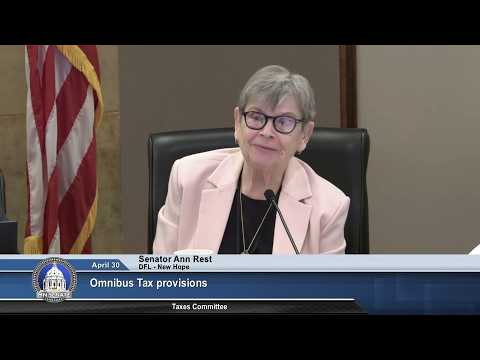
Chair Rest opened the session and guided the committee through a series of author and member amendments before the final recommendation. "The quorum is present," she said at the outset, and later summarized the bill's headline provisions, saying the measure "makes life more affordable" by, among other items, increasing property-tax refunds and establishing program-specific taxes and credits.
Why it matters: The bill would deliver a one-time 12% increase in property tax refunds, which Chair Rest said totals more than $100,800,000 in direct relief for homeowners; committee vice chair Grant Hauschildt said nearly 80% of Minnesota households would benefit. Chair Rest also said the bill includes $2,000,000 in aid to help communities recover costs tied to the recent federal "metro surge" enforcement action and creates a 0.25-cent Hennepin County health-care local tax intended to stabilize hospitals in Hennepin County, including Hennepin County Medical Center (HCMC) and North Memorial. "The dollars going to North Memorial in this proposal must be used for the cost of uncompensated care," Chair Rest said.
Key amendments and debate: The committee adopted an author 11 amendment that, according to Senate counsel Miss Pollock, corrected effective dates for the beginning-farmer credit and extended a report due date, increased the border city development zone income tax credit from $3,000 to $5,000, clarified a sales-tax exemption for the Browerville School District to cover materials used or consumed in a project, and adjusted project costs and bonding authorizations for multiple local sales-tax projects. Pollock also said A11 inserted provisions from another bill that would impose a tax on amounts obtained through public-program fraud.
Member amendments adopted included: - A3 (offered on behalf of Senator Miller): clarified that Big Ten conference tournaments would be eligible for the sports-events credit and allowed entities other than the University of Minnesota to perform the post-event tax analysis if the university could not; Senator Miller described it as a technical change the university requested. - A5 (offered by Senator Nelson): a housing-tax-credit clarification aligning income limits with existing workforce housing law so certain recipients are not subjected to a restriction. - A9 (offered by Senator Dibble): revised eligible expenses and certification procedures for aid tied to federal enforcement actions, removing legal expenses from eligible costs, adding vehicle towing and impoundment as eligible costs, shifting proactive certification away from the state auditor to local official attestation (notarized) while preserving audit authority for the state auditor, and permitting limited Department of Revenue administrative costs.
On the floor of the committee, most amendments were adopted by voice vote. Senator Dibble framed the A9 change as a response to conversations with the state auditor and local governments, saying it was intended to balance eligibility, local certification, and state oversight. Senator Nelson said A5 aligns the income levels with existing law so working households can qualify for workforce housing incentives.
Other notable policy provisions described by committee leaders included a sustainable aviation fuel (SAF) credit of up to $1.50 per gallon to promote in-state SAF production and lower life-cycle greenhouse gas emissions; several agriculture provisions, including an increase or clarification of the beginning-farmer credit; and a social-media tax that Chair Rest said would apply to the state's 14 largest global social platforms that do business in Minnesota and would generate "millions" in revenue without directly charging Minnesota users.
Votes and procedure: The committee moved to take Senate File 5052 from the table, adopted A11 and multiple member amendments by voice votes, then approved the motion to recommend the bill to the Senate floor. Chair Rest later moved to reconsider the first recommendation to ensure staff were instructed to make technical and conforming changes; that motion passed and the committee approved a final motion recommending passage and instructing staff to make technical corrections.
What—omes next: The committee recorded its recommendation to the Senate floor; leaders will determine when SF 5052 will be scheduled for floor consideration. Chair Rest said the bill must still pass the House ("A bill has to pass the house first") for enactment, and the committee awaits action there.
Quotes: "This tax bill delivers by providing a 12% property tax refund increase for this year," said Vice Chair Grant Hauschildt. Senator Dibble said the SAF credit and related agricultural incentives "position Minnesota at the forefront of a rapidly growing global industry." Chair Rest emphasized the bill's bipartisan elements: "This bill has features that are brought by members of both parties, both caucuses, on behalf of their constituents."
Ending: The committee adjourned after its final recommendation; Chair Rest thanked members, staff and outside participants and said the Senate is ready to bring the bill to the floor when leaders schedule it.