Get Full Government Meeting Transcripts, Videos, & Alerts Forever!
Get email alerts on the Kelp Aquaculture topic
No spam. Unsubscribe anytime.
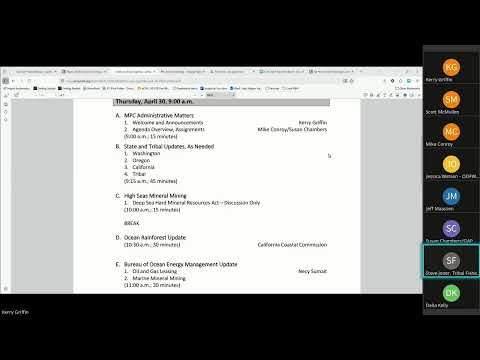
Fishermen warn of biofouling and trawl conflicts as California Coastal Commission presents Ocean Rainforest kelp project
Summary
The California Coastal Commission updated the committee on the Ocean Rainforest kelp aquaculture project (submerged cultivation lines at ~10–15 m depth). Presenters said monitoring and decommissioning plans are still being refined; fishermen raised concerns about mussel biofouling, lost buoys and anchors, entanglement risk, shell accumulation and potential long‑term impacts to trawl grounds.
Heather McNair (California Coastal Commission) presented an overview of a kelp cultivation project that would use suspended cultivation lines seeded with giant kelp placed roughly 10–15 meters below the surface. "It's a mix of muddy bottom and sand out here, but it's too deep for kelp to grow from the benthos... their design is this... grow surface area here," Heather said. The project design places cultivation lines and buoys that would keep kelp suspended well above the seabed.
Fishermen raised operational and ecological concerns. Gary Burke, a Santa Barbara trawler, described heavy mussel fouling on pilot buoys and asked how managers would address large areas with many buoys: "How are they ever gonna clean that up ... This is right in the middle of trawl grounds. We're gonna lose a massive area." Another participant reported pilot project losses of buoys and anchors and asked how decommissioning would restore trawlability.
Heather acknowledged the issues and said monitoring and maintenance are required: "For their pilot project, Ocean Rainforest has had to have a third party, monitoring team go out every 2 weeks to look at the gear..." She said the details of maintenance frequency, fouling mitigation and decommissioning remain under development and that those specifics will inform the consistency review.
Other questions addressed the potential for non‑target species biofouling (mussels, skeleton shrimp), the risks of marine debris and entanglement, and whether cultivation might seed nearshore kelp populations (a potential benefit flagged by some divers). The presenter said the draft EIS/consistency review and required monitoring reports will be used to assess impacts and mitigation needs.
Next steps: Coastal Commission materials and monitoring reports were referenced and the committee requested follow‑up details on the applicant's biofouling plan, decommissioning requirements and how mariner safety and trawl recovery will be assured.