Get AI Briefings, Transcripts & Alerts on Local & National Government Meetings — Forever.
Panelists at Columbus forum press for faster LinkUs transit expansion and warn of harms from car dependence
Summary
At a Columbus Metropolitan Club forum, authors Sarah Goodyear and Doug Gordon and COTA mobility director Devayani Puranic urged faster delivery of LinkUs transit improvements, described the public‑health and equity harms of car dependence and encouraged residents to support demonstration projects and attend COTA public meetings.
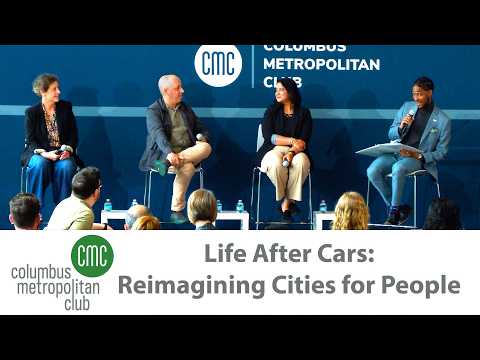
Columbus — At a Columbus Metropolitan Club forum at the National Veterans Memorial and Museum, authors Sarah Goodyear and Doug Gordon joined Devayani Puranic, mobility development program director for the Central Ohio Transit Authority (COTA), to argue that stronger transit and street redesigns are needed to reduce the harms of a car‑centered city and to press for timely delivery of LinkUs projects funded by a 2024 sales‑tax levy.
The panelists said the consequences of planning that assumes universal car ownership are wide‑ranging. Devayani Puranic noted that COTA’s 2014–2017 system redesign set the stage for a 2019 ridership high and that the 2024 levy has created an opportunity to expand service and infrastructure: “Our levy passed, and that's when LinkUs vision became a reality for us,” she said, describing three proposed bus‑rapid‑transit corridors, a short‑range plan that recommends roughly 14 higher‑frequency lines and proposals to boost service 20–30 percent over five years.
Why it matters: Panelists framed transit investment as an equity and public‑health issue, not just a convenience. Sarah Goodyear recounted the case of Raquel Nelson, a mother who was criminally charged after her child was struck while crossing where no crosswalk connected a bus stop to an apartment complex, to illustrate how poor street design can punish people who rely on walking and transit. “We are criminalizing normal human behavior,” Goodyear said, arguing traffic violence exacts disproportionate harm on Black and brown communities and saying the United States’ traffic‑fatality rate is higher than comparable wealthy nations.
Panelists also highlighted economic returns from well‑planned corridors, citing examples where bus rapid transit spurred private investment and housing near transit. Devayani said COTA’s analysis shows potential for substantial transit‑oriented housing along LinkUs corridors and said agency plans include new hospital and university connections and an OSU–airport alignment being studied.
On technology and costs: The forum addressed autonomous vehicles and transit finance. Doug Gordon warned that autonomous vehicles could worsen congestion because of extra vehicle‑miles traveled and “deadheading,” saying, “AVs will only make that problem exponentially worse.” In a separate audience exchange, member Scott Whitlock cited a figure of more than $8 per passenger mile for local buses; COTA staff said they would follow up with a specific cost‑per‑passenger‑mile calculation while noting highways and driving are subsidized through taxes and maintenance costs.
Accessibility and operations: Panelists and COTA officials described existing ADA features and services. Devayani said COTA’s fixed‑route buses are ADA accessible, drivers receive disability‑assistance training, and COTA operates a paratransit service called Mainstream (on‑demand ADA service) with accessible vans. She also said COTA expects to expand COTA Plus microtransit zones and tentatively plans three more zones over the next five years as part of short‑range adjustments aligned with LinkUs.
Tactics and political will: When asked for tactics that citizens can take, the authors urged demonstration projects and more visible pilot work — pop‑up bike lanes, open‑streets events and small physical demonstrations to help residents imagine changes. Goodyear also pointed to examples of political leadership overseas, saying that mayors willing to take heat for public‑space changes can change city trajectories.
Public participation: Devayani invited the public to COTA’s short‑range‑plan public meetings this week to give feedback on new alignments, frequency changes and expansion priorities. The forum closed with an appeal from Columbus Metropolitan Club leaders for listening, civic courage and inclusive planning.
What’s next: Panelists and COTA staff encouraged residents to attend public meetings on the short‑range plan and to contact elected officials in support of specific transit and street improvements. The CMC also announced its next forum topic and a book‑signing opportunity for the authors.