Get Full Government Meeting Transcripts, Videos, & Alerts Forever!
Get email alerts on the Transportation Funding topic
No spam. Unsubscribe anytime.
County engineering director outlines $1 billion list of state-road priorities and urges 2026 bond; discusses outer loop, US‑380 and transit options
Summary
During a transportation update, the county engineering director summarized decades of growth, progress on the outer loop and US‑380 projects, identified roughly $1 billion in prioritized state-road needs, and told commissioners staff recommends exploring a 2026 bond and legislative outreach to secure funding.
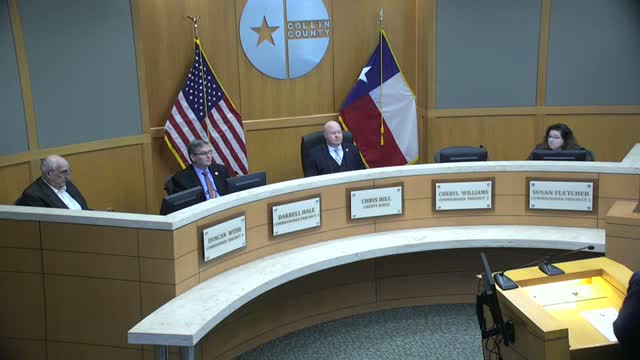
The Collin County director of engineering presented a wide-ranging transportation update to the Commissioner’s Court Thursday, summarizing past planning work, the status of outer loop and freeway projects, and a recommended set of priorities and funding steps — including a possible 2026 bond measure.
The director reviewed recent public engagement on the 2025 thoroughfare plan, the Southeast Mobility Study conducted with consultants Burns & McDonnell and Kimley‑Horn, and the county’s strategy for protecting freeway corridors through right-of-way acquisition ahead of development. He described a phased approach for the Collin County Outer Loop — building service roads first, then main lanes as demand grows — and said the county has already completed about 18 miles of new concrete service roads in recent years.
On funding, staff presented a prioritized list of state‑road improvements that "totals approximately $1,000,000,000," and recommended steps including another bond program in 2026, targeted right‑of‑way acquisitions, and outreach to state legislators to press for higher state allocations. "We feel like we've got to be moving faster than we've been moving," the director told the court, arguing the pace of development and changing development law requires accelerated action.
The presentation explained why the county and TxDOT must coordinate: some alignments (especially Farm‑to‑Market and state highways) are ultimately TxDOT projects, but the county can preserve corridors, fund design or buy right-of-way to accelerate state-led construction. Staff cited examples of prior county contributions that helped move TxDOT projects forward, and discussed the county’s historic bond programs (2018 and 2023) and their differing allocations.
The director also summarized transit planning work done with the regional council of governments and noted that while micro‑transit or bus rapid transit are options, little definitive action on fixed‑route transit has been implemented county‑wide; staff recommended continued study.
Commissioners asked about partnering with TxDOT on design and right-of-way to accelerate projects and emphasized the need to present legislators with realistic cost estimates. The director said state funding constraints mean counties often must contribute to get projects advanced, but stressed the county will prioritize and seek partners when appropriate.
Staff listed next steps: continue corridor studies (including Outer Loop segment 5 and the Northeast Freeway study), refine a 2026 bond proposal, pursue targeted right‑of‑way acquisitions, and prepare materials for legislative advocacy.