Get Full Government Meeting Transcripts, Videos, & Alerts Forever!
Get email alerts on the Criminal Justice Diversion topic
No spam. Unsubscribe anytime.
Bexar County lays out diversion strategy as partners warn of inpatient‑bed losses
Summary
County staff presented a detailed plan to expand deflection and diversion programs to reduce jail population, citing pilots and residential treatment placements; public commenters urged transparency after custody deaths and partners warned that regional inpatient capacity is shrinking, complicating plans.
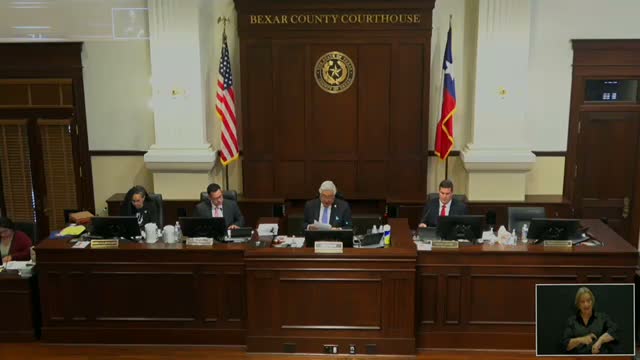
County staff and a wide panel of health and justice partners spent the bulk of the April 28 Bexar County Commissioners Court meeting laying out the county's current deflection and diversion work and next steps to reduce the jail population.
Thomas Guevara of the county manager's office opened the presentation by distinguishing "deflection" — interventions before arrest — from "diversion" — programs that occur after arrest but before conviction. He told the court staff would review existing efforts, results from pilots and remaining gaps.
Antonio Salazar Rosas, pretrial services manager, described a County Court 2 pilot that began in August 2024. He said the program has generated roughly 226 referrals since December 2025; 109 people are currently engaged in programming, 55 have completed outpatient treatment and 59 were referred to higher levels of care or had their cases adjudicated and closed. Salazar Rosas said many services have been delivered through partnerships with providers such as Continuum and Lifetime Recovery.
Dr. Andrea Guerrero, director of the Bexar County Department of Public Health, summarized public‑health deflection strategies and funding: she said much of the residential‑treatment work has been supported by opioid settlement funds and ARPA allocations paid to community providers, while mobile crisis teams and school‑based mental‑health prevention relied on a mix of general‑fund and ARPA support. She noted the county is tracking program outcomes (recidivism and days to rearrest) to identify which investments yield the biggest reductions in later jail use.
Several public commenters urged stronger oversight and transparency. Lydia Leos, whose son Julian Denna died after an encounter with the jail system, asked for immediate family notification policies, clearer medical‑care standards inside custody, and investigations when deaths occur. Goldie Vanzant of the Texas Jail Project urged the court to pair any diversion center proposal with deeper analysis of custody deaths and psychiatric wait‑list data before committing substantial resources.
Regional partners warned of looming capacity problems. Eric Eppley of STRAC told the court that the likely near‑term loss of a large inpatient facility would remove hundreds of psychiatric beds from the region and said the SMART mobile crisis teams — which he credited with thousands of non‑arrest responses last year — are at risk without faster contract resolution. Jarvis Anderson, director of community diversion and corrections, said Applewhite, a new 130‑bed dual‑diagnosis facility, is ready but underused because medication‑funding rules have kept patients from moving there; county staff proposed a short‑term $60,000 opioid‑settlement purchase of psychotropic medications to shift about 100 people into that facility within months.
Commissioners emphasized coordination. Several members said diversion is only one leg of a multi‑part strategy that also requires expanded inpatient and outpatient capacity, improved court throughput, and better cross‑agency intake (including eliminating duplicative magistration steps so diversion opportunities are not lost in processing delays). The court directed staff to continue working with partners, to brief the court on metrics and funding sustainability, and to return with more detailed implementation options and estimates.
The presentations and public testimony made clear the court faces two simultaneous challenges: sustaining program momentum as grant and ARPA dollars expire, and avoiding a shortfall in bed capacity if regional inpatient providers reduce or pause services. Commissioners said they expect more follow‑up briefings and recommended the county prioritize near‑term fixes — such as the Applewhite medication plan — while pursuing longer‑term structural changes.
Next steps identified by staff included standardized performance metrics across funded providers, a feasibility timeline for converting short‑term ARPA or opioid investments to recurring sources where appropriate, and continued outreach to the district attorney, sheriff and city partners to reduce process delays that undermine diversion.