Get Full Government Meeting Transcripts, Videos, & Alerts Forever!
Get email alerts on the State Budget topic
No spam. Unsubscribe anytime.
Connecticut Senate approves 717‑page affordability package after heated debate over spending caps
Summary
The Connecticut Senate passed Senate Bill 1, a 717‑page budget adjustment described as an 'act concerning affordability,' after hours of debate over municipal aid, education funding, hospital reimbursements and the governor's emergency declaration; the Senate rejected a Republican alternative and approved the amended bill 30–6.
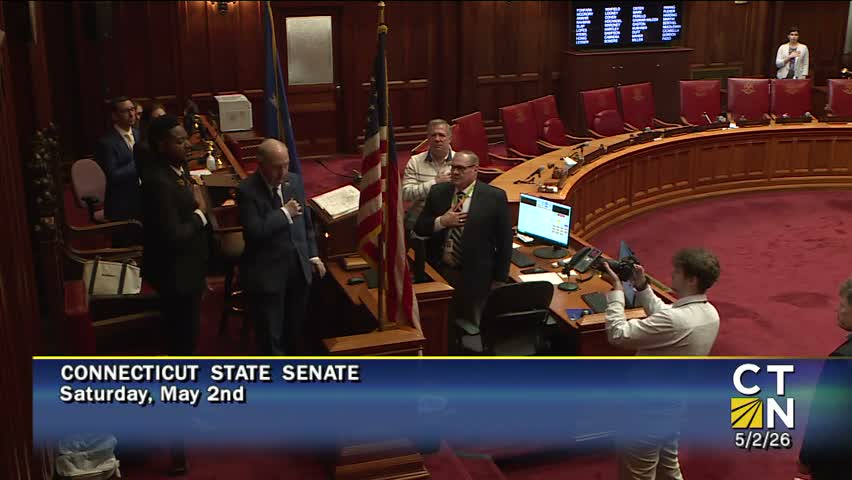
The Connecticut Senate on May 2 approved Senate Bill 1, an amended 717‑page budget adjustment billed by sponsors as an affordability package that increases education and municipal aid, adds targeted tax relief measures and bolsters hospital reimbursements. The chamber passed the bill, as amended, by a roll call of 30–6 and immediately transmitted it to the House of Representatives.
Senator Beth Austin, the bill’s floor proponent, summarized the strike‑all amendment as a comprehensive implementer that adjusts appropriations in fiscal years 2026 and 2027 and keeps the package “under the spending cap by $600,000.” She described the $28.142 billion measure as addressing education funding, municipal aid and a range of health‑care fixes, including targeted support for hospitals in Waterbury, Manchester and Vernon and steps to unwind parts of the Office of Health Strategies.
The bill includes a $100 million allocation to municipalities distributed through a formula sponsors said is modeled on the Mashantucket‑Mohegan fund, an expanded education cost‑sharing investment, and measures designed to increase Medicaid reimbursements and shore up hospitals. Sponsors also pointed to a set of tax provisions that they said would provide relief to households — including a sales‑tax holiday expansion and targeted credits — and to a $300 million early‑childhood endowment aimed at reducing child‑care costs over time.
“This is actually, in my opinion, one of the best budgets that we have brought forward,” Austin said in her floor summary, laying out the bill’s mix of program funding, reallocated grants and statutory changes.
Opponents — led by Senator Rob Fazio and other Republican members — argued the bill exceeds the legislature’s fiscal guardrails and criticized the timing and process. Fazio offered a Republican substitute (LCO 5764) that he described as a compromise that would strengthen guardrails and return roughly $750 million in middle‑class tax relief. He called for a roll call vote; the amendment failed 11–25.
“Once this budget adjustment document is passed … we are going to eviscerate the budget guardrails we already have passed,” Fazio said, urging a different fiscal path and warning of added borrowing.
Several members criticized the speed of the process. Senator Heather Summers pressed sponsors about receiving a 717‑page package in the early hours and having less than the chamber’s 12‑hour review period. “This is a disservice to the citizens of Connecticut,” Summers said, noting concerns about public hearings and limited time to review the extensive implementer language.
Supporters countered that the package responds to federal changes and urgent needs. Senator Martin Looney, who spoke in favor on the floor, framed the bill as an investment to help communities cope with federal reductions and longstanding local funding shortfalls. He highlighted the early‑childhood investment and increases to Medicaid rates as measures intended to improve access and affordability.
The bill also contains policy and implementer sections addressing health‑care contracting language, a Connecticut option study and a clarified line item for an Innocence Project revolving loan account (a $400,000 appropriation previously embedded inside a larger legal aid line but now placed on its own line so the judicial branch can use it). On that point, Senator Kissel sought detail on implementation; sponsors said the judicial branch will define parameters for the loan account.
Senators debated both policy and process for several hours, including the use of a gubernatorial emergency declaration that sponsors said exempted portions of appropriations from the spending‑cap calculation. After further remarks from members on both sides, the Senate took a final roll‑call vote and passed the bill as amended.
The next step is transmission to the House of Representatives; sponsors indicated the House would receive the measure immediately. Senate leaders announced the body will reconvene Monday at 11:00. The bill’s detailed provisions and their implementation timelines remain subject to administrative rules and future committee oversight where required.