Get Full Government Meeting Transcripts, Videos, & Alerts Forever!
Get email alerts on the Sb 588 topic
No spam. Unsubscribe anytime.
Assembly hearing finds SB 588 gave new collection tools but gaps remain in recovering stolen wages
Summary
At a California Assembly Committee on Labor and Employment hearing, advocates, workers and the Labor Commissioner agreed SB 588 (2015) improved enforcement—adding liens, levies and individual liability—but witnesses urged earlier prejudgment tools, more Judgment Enforcement Unit staff, and statutory fixes to stop owner asset transfers that leave workers unpaid.
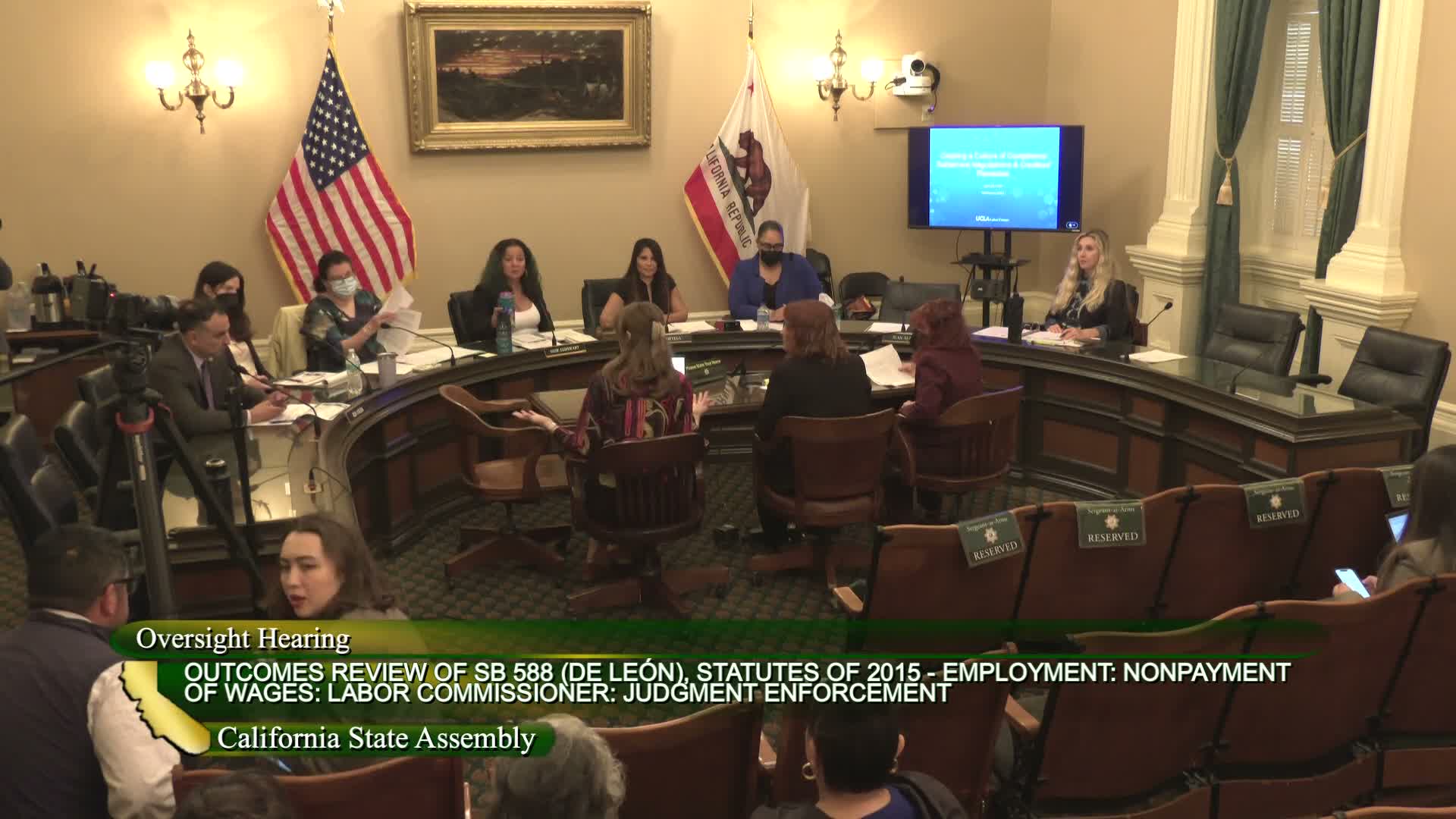
The California State Assembly Committee on Labor and Employment on Thursday held an oversight hearing on SB 588 (De León, 2015), assessing whether the law’s creditor‑style tools are delivering money to workers and where enforcement falls short.
The committee heard that SB 588 gave the Labor Commissioner powers to name individuals and joint employers, place liens and use levies and receivership to collect unpaid wages. “SB 588 lets the labor commissioner act like a creditor,” said Tia Koons, policy director at the UCLA Labor Center, who told the panel these tools have increased the chance that workers receive payment after lengthy adjudication.
Why it matters: Wage theft remains widespread, advocates told the committee. Chair opened the hearing by noting a 2024 backlog of roughly 47,000 unprocessed claims and cited state audit findings that only a small share of claimants recover full awards without enforcement help.
How the tools work: Chloe Ozmer, executive director of the Maintenance Cooperation Trust Fund, described cases in which joint‑and‑several liability and other SB 588 remedies pushed large client employers to resolve claims. She cited settlements and enforcement actions involving Tesla, The Cheesecake Factory and Optum Health that returned substantial balances to janitorial and cleaning staff.
Agency results and limits: Labor Commissioner Lilia Garcia Brower said the agency recovered about $78 million in unpaid wages in 2025 across enforcement programs, including $41 million from the wage claim adjudication program (a 33% increase from the prior year). The Judgment Enforcement Unit (JEU) has grown from a handful of staff to 33 authorized positions, she said, and the JEU reports a roughly 46% recovery rate for judgments in the first year, up from about 17% before SB 588’s tools were used aggressively.
Gaps and proposed fixes: Witnesses and worker advocates urged legislative changes to preserve assets earlier in the process. “There are states where workers can file a prejudgment lien as soon as a dispute begins,” Tia Koons said, urging removal of the current California requirement that prejudgment liens be limited to employers with an existing unpaid judgment. Ruth Silbertaup, supervising attorney at the Alexander Community Law Center, offered an eight‑point plan that includes making license denials or suspensions mandatory for judgment debtors in regulated industries, expanding upstream liability beyond property services, funding more JEU positions, and widening the availability of prejudgment liens.
Worker testimony: Residential care workers and caregivers described long delays and difficulty collecting awards even after winning judgments. “Even when caregivers win their cases and receive judgment, the struggle is not over,” testified Tess Briante, who said unpaid night checks and unpaid overtime were routine at her facility.
Next steps: Committee members pressed the Labor Commissioner on metrics and asked whether the agency’s recoveries track the broader estimated scale of wage theft. Commissioner Brower said internal data are limited but pointed to the state auditor’s finding that 72% of wage claims are resolved by settlement and noted the agency’s budget change proposal seeking additional JEU staff.
The hearing closed with supporters urging targeted enforcement focused on bad actors and continued legislative oversight of SB 588’s implementation.