Get AI Briefings, Transcripts & Alerts on Local & National Government Meetings — Forever.
Legislators discuss one‑time funds to ease CSU capacity gaps and UC health‑workforce startup requests
Summary
The subcommittee reviewed CSU plans to reallocate enrollment funding and asked whether one‑time funds should bridge capacity shortfalls at overtaxed campuses; UC requested start‑up (one‑time or ongoing) funds to launch four health‑professional programs projected to add about 120 graduates a year to underserved regions.
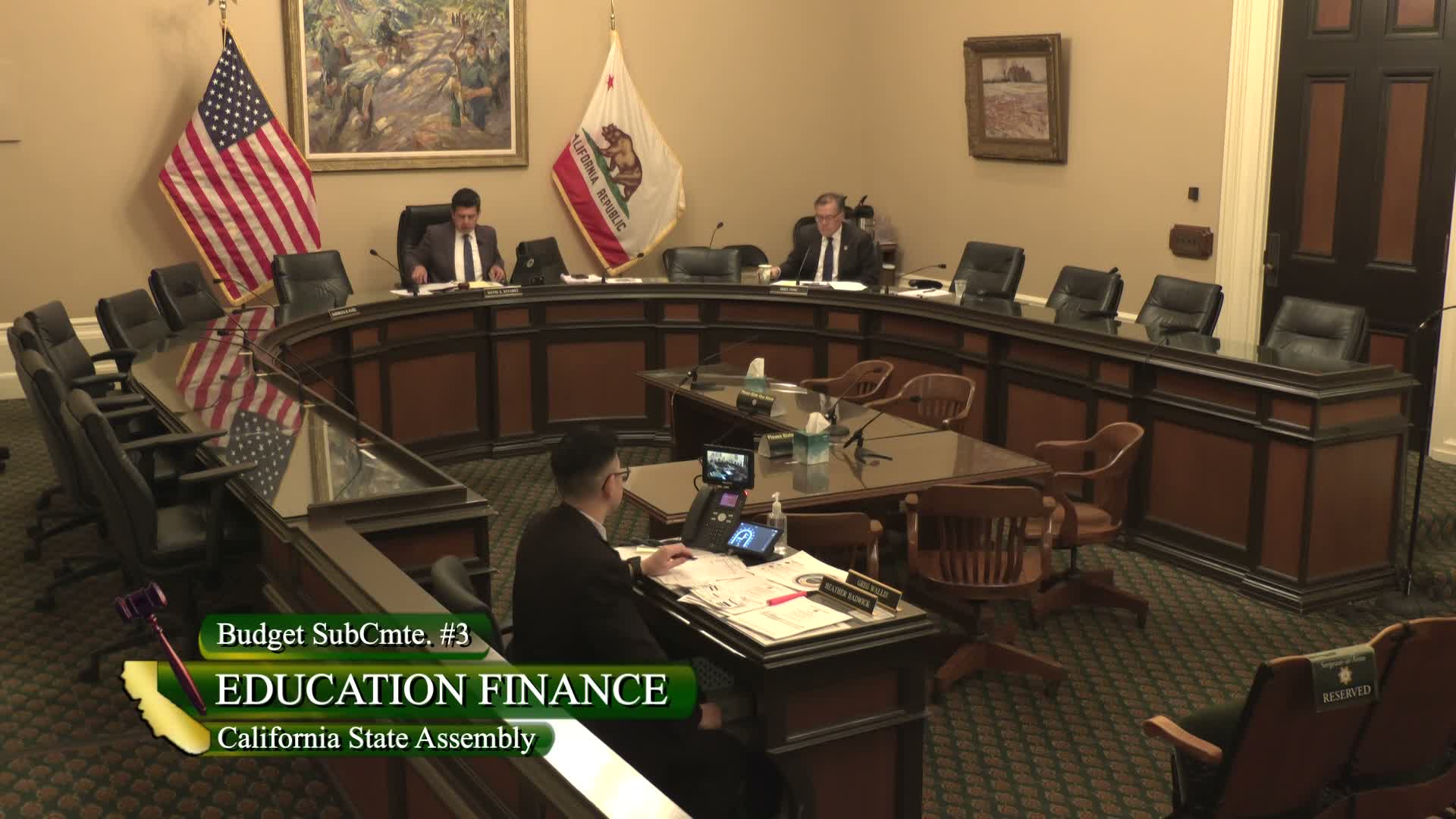
The subcommittee discussed proposals to address uneven enrollment pressure across California State University campuses and a related set of University of California requests to expand health‑profession programs.
CSU officials told the panel they expect to shift nearly $90 million in ongoing funding over a multi‑year reallocation to align funding with actual enrollment and regional needs. Mark Martin (CSU) said one‑time funds have been used in prior years to help high‑demand campuses expand course offerings, pay part‑time faculty and grow summer programs, and could be useful again as a bridge during reallocation.
Nathan Evans of the CSU chancellor’s office proposed four workforce‑focused paths that could be accelerated with one‑time startup funds: expanding RN‑to‑BSN and concurrent enrollment pathways with community colleges, certified wellness coach pathways, psychiatric mental‑health nurse practitioner capacity, and a multi‑campus physician assistant consortium.
The Legislative Analyst’s Office cautioned that enrollment growth is an ongoing cost and recommended using marginal‑cost calculations when funding slots; LAO staff also warned against launching programs without an out‑year funding plan. The panel asked CSU to explain how one‑time funding would transition to ongoing support if programs scale.
University of California representatives asked for $11 million in one‑time start‑up funding (or $5.5 million ongoing if the Legislature prefers) to create four new health‑professional programs (dentistry, pharmacy, optometry and veterinary programs) designed to recruit and train clinicians committed to underserved regions; UC estimated the four programs would produce roughly 120 graduates annually when fully implemented. UC also made additional one‑time requests for ASSIST upgrades, an AI initiative, disability services supports and proof‑of‑concept commercialization funds.
Committee members said they support targeted workforce expansion but sought more detail about ongoing costs, timelines, clinical supervision and metrics for retaining graduates in underserved communities. The items were held open for follow‑up.