Get Full Government Meeting Transcripts, Videos, & Alerts Forever!
Get email alerts on the Defense Production Act topic
No spam. Unsubscribe anytime.
Expert tells Alaska Senate panel DPA could aid but won’t likely nationalize proposed LNG pipeline project
Summary
An expert told the Alaska State Senate Resources Committee that the Defense Production Act (DPA) could provide loan guarantees, grants or offtake agreements to support a proposed Alaska gas/LNG project but that applying DPA at the scale discussed would be novel, legally uncertain and unlikely to result in federal nationalization.
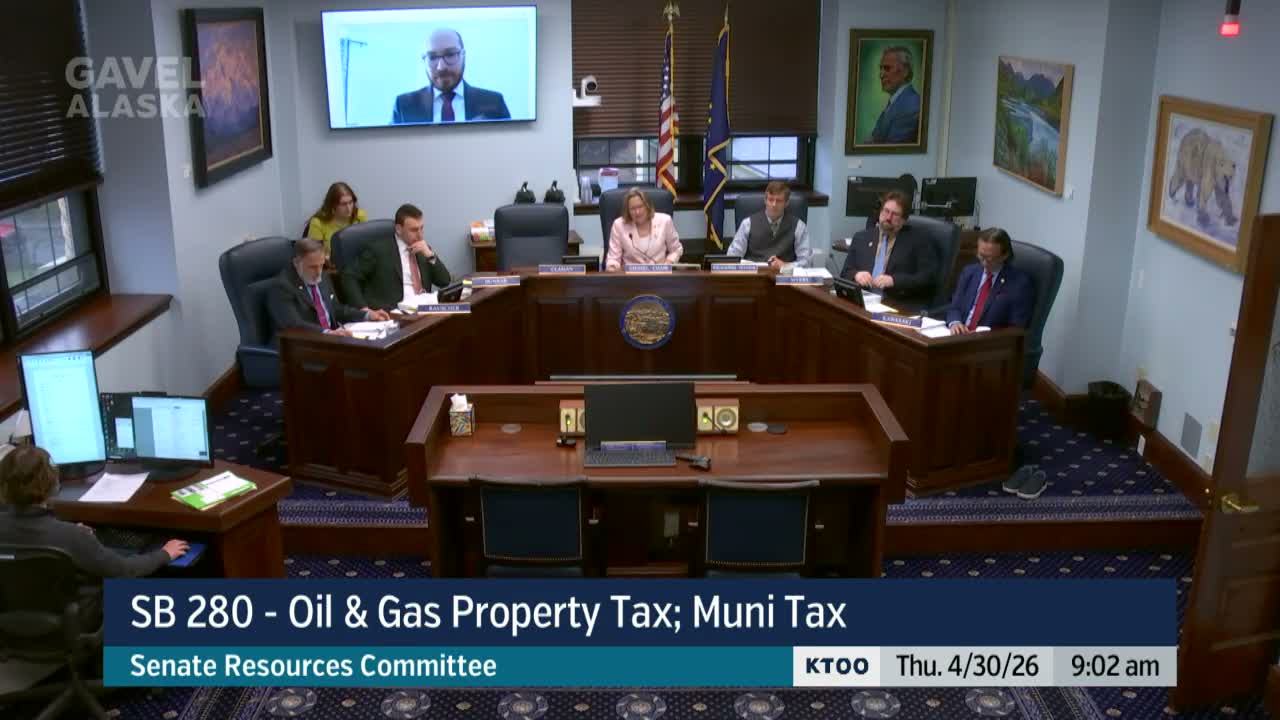
The Alaska State Senate Resources Committee heard expert testimony April 30 about how the federal Defense Production Act could be applied to a proposed large-scale Alaska gas treatment, pipeline and LNG export project.
Philip Rossetti, a senior fellow for energy and environment at the R Street Institute, told the committee the DPA offers two common authorities: Title I, which allows prioritization of contracts for national-defense purposes, and Title III, which provides a Defense Production Act Fund that can subsidize or lend to industries considered essential to national defense. "When the president waived these requirements, which the president did on April 20, he is permitted to use the DPA fund for these purposes without adhering to these normal constraints," Rossetti said.
The committee’s chair framed the discussion around a proposed project the chair described as a "giga project" — a gas treatment facility, pipeline and LNG facility — with an estimated cost the chair said is about $47,000,000,000. Rossetti said DPA aid typically has been small relative to that scale and that using the DPA to subsidize construction of a mega-project would be a novel application. "Loan guarantees can cover a larger portion of that cost, and the scope of that depends somewhat on limitations and the estimated subsidy value of the risk of the project," he said.
Sen. Dunbar asked whether DPA support would change ownership of the pipeline or LNG assets. Rossetti replied it generally would not, saying grants or prioritizations are given to private companies and that Title VII liability limitations can sometimes accompany DPA actions to limit certain liabilities, though he cautioned these are not blanket waivers.
Committee members pressed legal and political limits. Vice Chair Sen. Wilkowski asked about the likelihood the federal government would effectively nationalize the $46 billion project; Rossetti said that prospect was "low," adding such intervention "would almost certainly do more harm than good" and could face legal challenge. On standing to sue, Rossetti said he was not aware of clear precedents of third parties successfully stopping DPA-backed projects and said Congress ultimately has authority to constrain the DPA's scope.
Members discussed precedent and comparable uses. Sen. Kawasaki and Sen. Kosaki cited a recent Fairbanks example involving US Antimony Corporation; Rossetti said DPA or similar federal support has been used for mines and critical-mineral projects because permitting and capitalization challenges make mining a common DPA application. He warned, however, that reliance on the DPA can distort private capital allocation if there is not a clear market failure.
Several senators raised state-level policy options tied to the project, including disclosure requirements, statutory deadlines with penalties, price caps and legislative approval of certain contracts. Rossetti cautioned that added transaction costs and existing federal laws in the natural gas sector (which require certain transparency) mean the legal and economic details matter in evaluating those measures.
The committee also discussed strategic uses of the DPA for military energy needs along the proposed corridor. Rossetti said prioritizing energy for military bases falls within DPA scope and noted the federal government has discretion to decide what it views as a secure energy source.
The committee chair raised fiscal transparency concerns, noting the proposal under consideration would eliminate property taxes for the duration of construction and for 10 years after production — a large revenue impact for local communities that may face workforce and service demands during construction. The hearing ended with the committee thanking the witness and adjourning; the next meeting is set for May 1 at 3:30 p.m., when the Department of Natural Resources divisions will testify and public testimony will be opened.
Rossetti’s testimony emphasized a central point for the committee’s deliberations: DPA tools exist that could be used to support parts of the project, but applying them at the scale described raises novel legal, economic and policy questions that would likely require congressional, administrative and possibly judicial clarification.