Get AI Briefings, Transcripts & Alerts on Local & National Government Meetings — Forever.
Mayors urge lawmakers to condition HB 381 tax breaks on spur‑line access, press for community benefits and affordability safeguards
Summary
Mayors from Fairbanks North Star Borough and Kenai Peninsula Borough testified before the House Resources Committee on HB 381, urging language that ensures a spur line (to serve interior communities) and that tax incentives yield affordable gas for local residents; they also pushed for community benefit agreements and clearer reimbursement for local impacts.
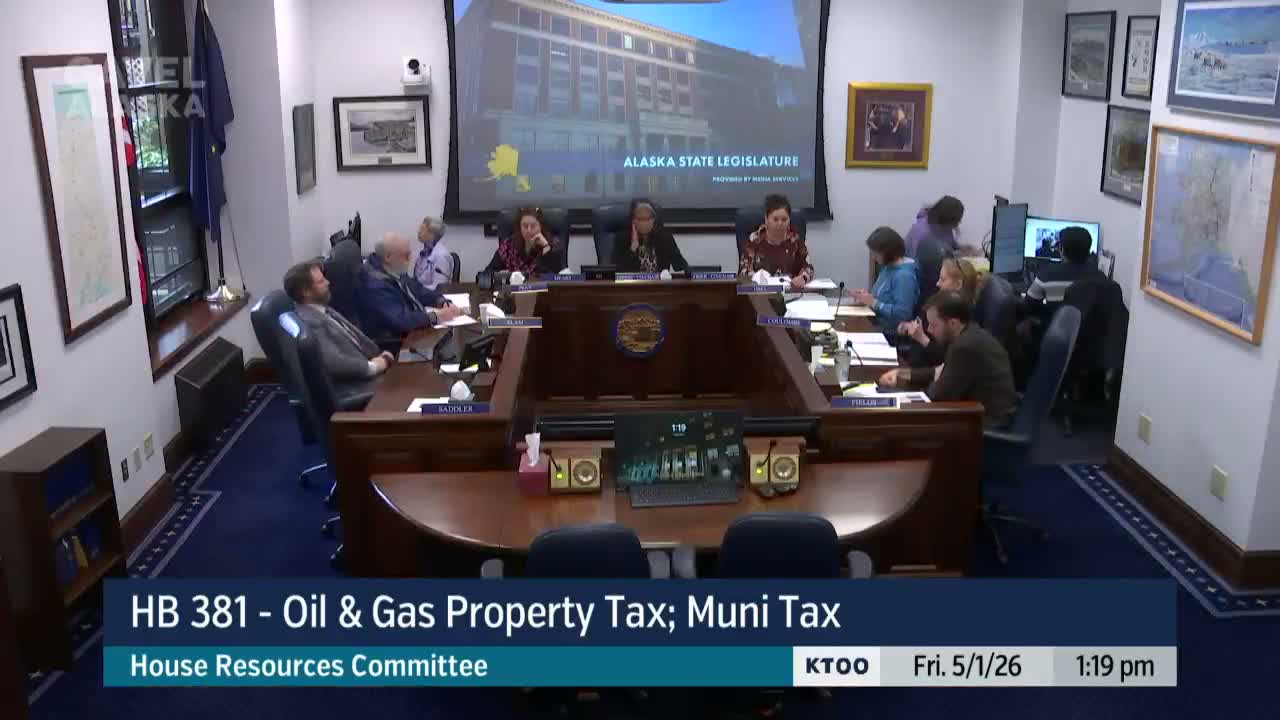
Mayors representing interior and peninsula communities told the House Resources Committee on May 1 that House Bill 381’s committee substitute must guarantee that tax incentives for the AKLNG project deliver affordable Alaska gas to Alaskans and address local construction and long‑term operating impacts.
Mayor Grier Hopkins of the Fairbanks North Star Borough said the substitute conditions tax benefits on delivering gas to Alaskans "at the Alaska price," and he emphasized the need for a spur line with sufficient capacity to serve projected residential, commercial and industrial demand in the interior. Hopkins said the CS does not force a particular company to build the spur but makes tax benefits contingent on the line’s delivering capacity and places oversight of spur‑line requirements under the Regulatory Commission of Alaska to ensure nondiscriminatory rates.
“We want to make sure that the gas that's delivered is affordable in the same way that's affordable to all the Alaskans,” Hopkins told the committee, and he said consultant modeling shown to the committee estimated the system tariff would add about 2¢ to the cost of gas once exports begin. Hopkins and other speakers discussed a spur‑line cost range frequently cited in testimony of roughly $150 million–$200 million (one reference put a spur cost near $180 million) and urged careful drafting to avoid a hard construction deadline that could imperil the main project if permitting delays occur.
Rep. Fields raised the option of using a notice‑to‑proceed (NTP) or an alternative trigger rather than "begin construction" to reduce risk from permitting and litigation; Hopkins said he and local stakeholders are willing to work with the committee on timeline and trigger language.
Mayor Kenai Peninsula Borough Michicky (Kenai) said he supports a volumetric tax (an ABT or throughput tax) over a traditional property tax structure, but cautioned that a 6¢ rate may not sufficiently protect borough finances. Michicky described negotiated community‑benefit approaches, suggested a combination of some upfront funds plus a list of "qualified costs" for reimbursement (roads, solid waste, emergency services, school impacts), and urged that the funding structure avoid shifting burdens to local taxpayers or undermining school funding.
Members questioned whether Interior Gas Utility’s contracts with existing suppliers could prevent rapid conversion to pipeline gas; Hopkins said affordability thresholds in those contracts (around $19 per thousand cubic feet) will be a key factor in whether local utilities can switch from trucked or contracted supplies to pipeline service.
Committee members and mayors agreed that community benefit agreements, negotiated locally under Title 29 authority, and clearer reimbursement mechanisms could help address construction‑era impacts (mayors cited roughly $10 million per year in construction‑period impacts for one borough) while preserving the project’s economic viability. The committee said it will receive updated Department of Revenue modeling at its next meeting on May 4 and consider amendments.