Get Full Government Meeting Transcripts, Videos, & Alerts Forever!
Get email alerts on the Veterans Sentencing Program topic
No spam. Unsubscribe anytime.
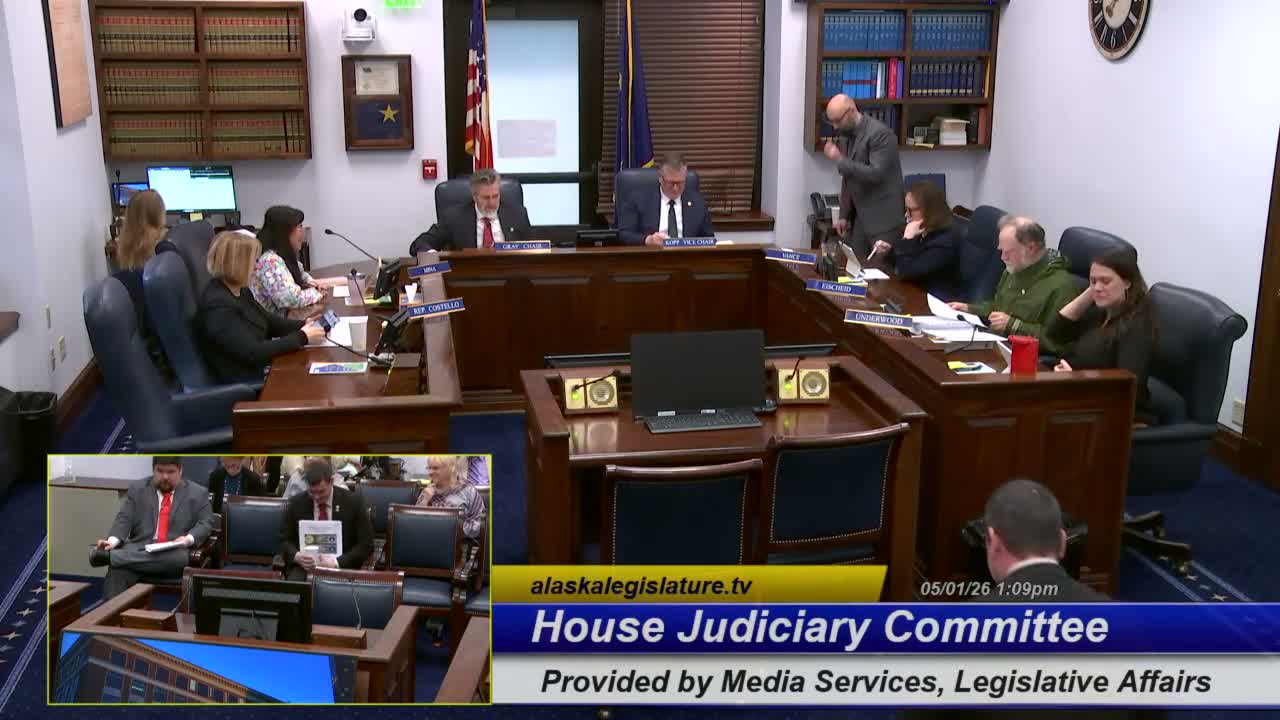
Rep. Will Stapp presents veterans sentencing bill; Dept. of Law warns of litigation and separation‑of‑powers risks
Summary
At a May 1 House Judiciary Committee hearing, Rep. Will Stapp introduced HB 299 to create a veterans sentencing program directing eligible veterans toward therapeutic interventions. Supporters cited Minnesota outcomes and federal funding opportunities; the Department of Law and Alaska court officials urged clarifying burden‑of‑proof, eligibility and statutory language to reduce litigation and align with existing therapeutic courts.
Juneau — Representative Will Stapp told the House Judiciary Committee on May 1 that House Bill 299, the Veterans Justice Act, seeks to codify and expand pathways for eligible veterans charged with low‑level misdemeanors to receive therapeutic interventions instead of traditional sentencing. "The overarching goal is to help veterans avoid involvement in the criminal justice system by directing them to the existing therapeutic court that exists," Stapp said.
Stapp and his staff (Bernard Iota) outlined a section‑by‑section structure that would add veteran‑identification steps for arresting officers (AS 12.25), require judicial officers to inform eligible defendants at first appearance, create a statutory Veterans Sentencing Program under AS 12.55.057, allow courts to set aside or reduce misdemeanor convictions on successful completion, and add data‑tracking duties for the Alaska Criminal Justice Data Analysis Commission. The bill includes an indirect court rule amendment that could require a two‑thirds vote and sets an effective date of July 1, 2027.
Brock Hunter, co‑founder of the Veterans Defense Project, testified in support and pointed to Minnesota experience in which a similar law produced reported cost savings and favorable completion rates. "Minnesota's legislative fiscal notes identified a cost savings of around $1,000,000 a year," Hunter said, and he added that Minnesota reporting showed 115 veteran cases with 91 successful completions under its scheme.
Committee members focused questions on how eligibility and proof would work in Alaska. Hunter said the draft as conceived places the burden on the veteran to produce evidence (VA or other medical records) demonstrating a service‑related condition, and that Minnesota set a clear‑and‑convincing standard in its statute. "The veteran has the burden of proof to show by clear and convincing evidence that they meet the criteria under the statute," Hunter said, describing Minnesota practice.
But Angie Kemp, deputy attorney general in the Department of Law's Criminal Division, warned that the current draft lacks an explicit burden‑of‑proof standard and other drafting specifics that she said would likely spawn litigation about who qualifies for the program, whether defendants have completed treatment, and which parties bear burdens in contested hearings. "Anytime the legislature can provide clarity on who bears the burden and in what scenario, that will reduce litigation," Kemp told the committee.
Kemp also flagged potential separation‑of‑powers concerns in the bill's use of terms such as "expungement," "dismiss," and "amend" that could be construed to transfer prosecutorial or executive functions to the judiciary. She said the draft might unintentionally create incentives for defendants to take cases to trial while still seeking program entry, and recommended legislative fixes to reduce those risks.
Nancy Mead, general counsel for the Alaska court system, told the committee that existing veterans and therapeutic courts are resource‑intensive and individualized, typically run by a multidisciplinary team and often last about 18 months. She cautioned that codifying a one‑size‑fits‑all model could be infeasible given limited treatment capacity outside Anchorage and Fairbanks and that the bill as drafted appears to create a different, "lighter" model than current therapeutic courts.
Committee members raised access concerns for rural veterans and asked about federal funding; Hunter said federal grant streams and Veterans Justice Outreach resources exist and are underused in some jurisdictions. Public testimony included both opposition and support from the same online participant (Mike *****), who argued at one point that lowering the veto‑override threshold in a separate item (SJR 2) would be harmful and later endorsed HB 299 as useful for veterans.
The committee did not vote on HB 299; Chair Gray set the bill aside for further work and signaled willingness from the sponsor to work with stakeholders, including the Department of Law and the court system, on drafting changes.
What happens next: Committee staff and sponsors are expected to draft clarifying language on burden and eligibility, work with the Department of Law and court officials on separation‑of‑powers concerns, and revisit HB 299 at a later meeting.