Get AI Briefings, Transcripts & Alerts on Local & National Government Meetings — Forever.
Alaska Housing Finance Corp. tells House Finance Committee rising costs, aging stock and labor shortages are squeezing housing supply
Summary
Alaska Housing Finance Corporation officials told the House Finance Committee that the state’s aging housing stock, construction labor scarcity and federal procurement rules are constraining new builds and driving up costs; AHFC said mortgage costs and home prices have risen sharply and promised a housing assessment by Q4 2026. The presentation included AHFC data methods, mortgage performance metrics and questions about Buy America rules and short‑term rentals.
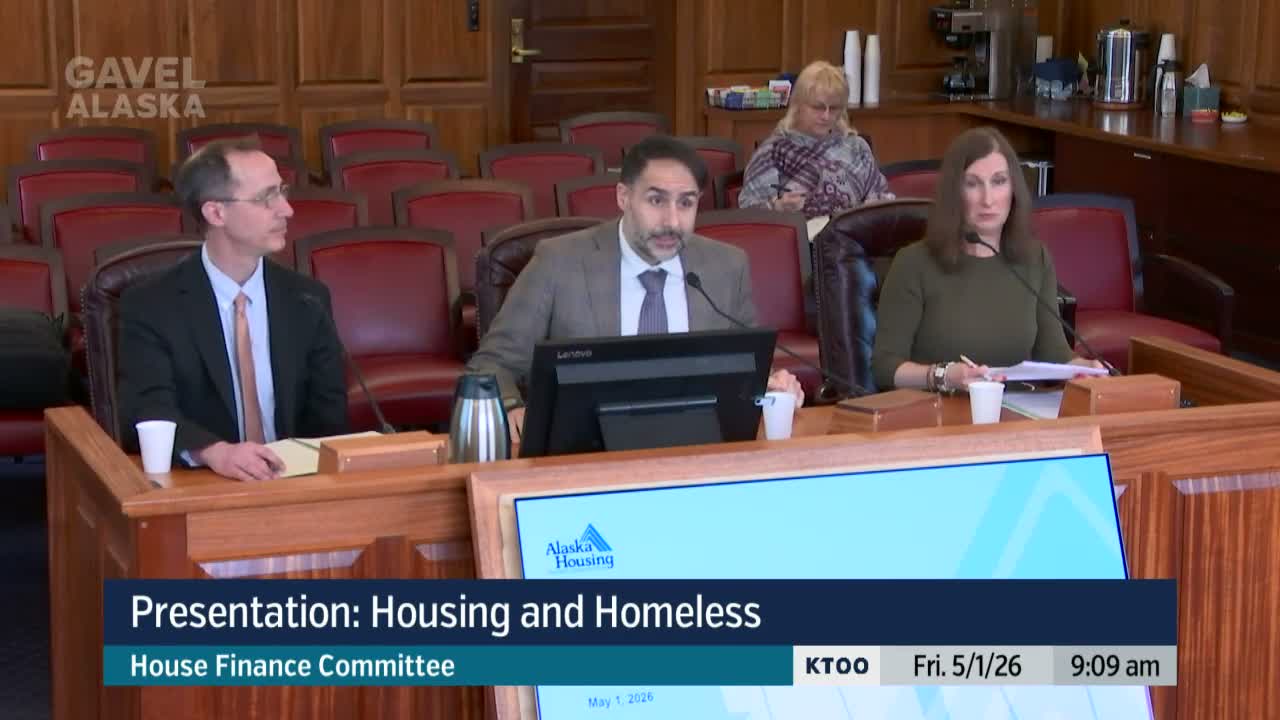
The House Finance Committee heard on May 1, 2026, that Alaska Housing Finance Corporation (AHFC) officials see multiple structural pressures limiting housing supply across the state, including aging stock, a shrinking skilled construction workforce and federal procurement rules that can make projects infeasible.
"The corporation's mission is to provide Alaskans access to safe, quality, and affordable housing," Deputy Director Ike Gilopsis said in opening remarks. He traced AHFC’s authority back to the agency’s legislative formation and its merger with the state housing authority, and said AHFC combines mortgage programs, tax‑credit financing and weatherization work to support housing access.
AHFC described the state’s housing stock as concentrated in units built during the 1970s and 1980s, creating higher renovation costs in Alaska’s climate. The agency said workforce constraints — fewer carpenters and skilled trades — have raised labor scarcity and driven up construction costs statewide.
AHFC officials also flagged federal rules, notably the Build America, Buy America requirements, as a constraint on some federally funded projects. "In some cases, it's an outright prohibition," Gilopsis said of Buy America limitations; in other instances, he added, the penalties or added costs make the per‑unit cost prohibitive. Committee members and AHFC staff said they have conveyed these problems to congressional delegates for potential advocacy.
On market trends, AHFC said mortgage and homeownership costs rose substantially as interest rates increased from the low post‑pandemic levels. The agency reported that homeownership costs have increased "over 60%" across the state since the low‑rate period and renter costs about "30%," though the magnitude varies by community. AHFC also cited an example average home price of $419,000 for 2015 in an illustrative chart and said reported loan volumes are lower than previously.
Stacy Barnes, AHFC director of government relations, briefed the committee on AHFC's financial position: the corporation recently achieved a AAA rating on mortgage revenue bonds and reported a foreclosure rate of about 0.1%. Barnes noted AHFC’s statutory dividend to the state, set at 75% of net income, and said the corporation's dividend this year is $54,000,000.
Committee members pressed AHFC on Alaska‑specific metrics. Representative Galvin asked whether the charts drew on national Association of Realtors figures; AHFC replied it conducts voluntary quarterly lender surveys and an annual rental canvass to construct Alaska‑specific measures and offered to provide more state‑level breakdowns in writing. AHFC said a broader housing assessment is in the field now and is expected by the fourth quarter of 2026.
On short‑term rentals, AHFC staff told the committee that listings sometimes function as workforce housing in smaller communities and that the agency began tracking those listings in 2021. AHFC estimated the share of the rental market that crosses to short‑term listings ranges roughly from 15% to 40%, depending on the community and survey response rates.
The presentation closed with AHFC offering follow‑up written materials and committing to share the housing assessment and additional Alaska‑specific data with the committee. The chair adjourned the meeting after brief member remarks.