Get Full Government Meeting Transcripts, Videos, & Alerts Forever!
Get email alerts on the Education Funding And Implementation topic
No spam. Unsubscribe anytime.
School leaders tell LESC that funding and behavioral supports, not new mandates, are priority to protect instruction
Summary
School superintendents and charter leaders at the LESC interim hearing said recent literacy and math investments show promise but stressed implementation gaps: time‑intensive training (LETRS), enrollment declines offsetting SEG gains, rising insurance and operating costs, and urgent need for behavioral and special‑education supports.
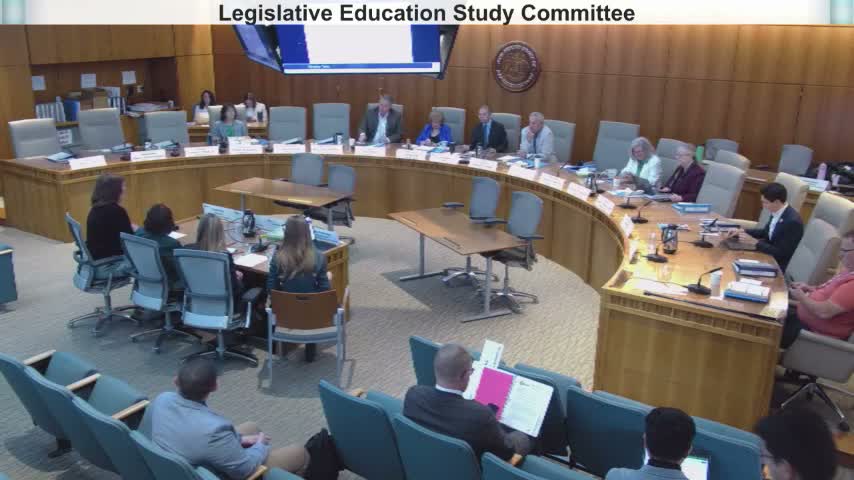
School leaders told the Legislative Education Study Committee on May 1 that New Mexico's policy investments in literacy and math are valuable but undercut by implementation challenges and rising costs that threaten classroom instruction.
Christine Griffin, superintendent of Santa Fe Public Schools, said the state has “embraced the science of reading,” but warned that adding multiple initiatives without protecting teachers’ planning time can erode classroom practice. “LETRS training takes a couple of years to get through, and it's quite a commitment of time for our teachers,” she said, describing the trade‑offs schools face when teachers must choose between professional development and daily planning.
Jennifer Guy, superintendent in Los Alamos, told the committee that an increase in the state equalization guarantee (SEG) has been largely offset in her district by enrollment declines and higher insurance and operating costs. Guy said Los Alamos expects major cost pressures next year from insurance premiums and other operating expenses and noted the district must cut positions such as math interventionists because of lost revenue.
Sarah Tarrio, director of McCurdy Charter School in Española, described the burden small schools face in meeting new program requirements. Tarrio said McCurdy has seen steady enrollment gains and academic improvement but must redirect scarce operational funds to cover mandated program requirements or staffing: “We applied for the revolving charter school loan fund, and the restrictions that were put on accessing that money eliminated us even though we were initially selected to receive it,” she said.
Across the panel, leaders pressed for investments that prioritize people: more behavioral specialists, school nurses, education assistants and interventionists, and for strategies that reduce leadership churn. “One of the things that I'm so passionate about is leadership turnover,” Guy said, arguing that frequent principal or superintendent turnover produces multi‑year disruption for students.
Members pressed the panel on where money is going and why many schools still cancel extracurricular travel or athletics despite large increases in overall education budgets. Panelists repeatedly said 80–90% of their operating funds go to salaries and benefits, leaving little discretionary capacity for activities, facilities or additional supports. McCurdy’s director said a change in the at‑risk units formula cost her school roughly $350,000, forcing staff and program tradeoffs.
Leaders also raised concerns about state testing and assessment tools, with several describing problems in the implementation and security of a platform variously called “Amira,” “Emera,” or “AMIRA” during testimony. Panelists reported inconsistent implementation across schools, excessive testing time, reporting errors, bandwidth problems and unresolved data‑security questions.
The committee acknowledged the implementation tension between statewide priorities and local capacity and asked staff to investigate district spending patterns and how funds are being used locally. Chair closed the panel by urging districts to document funding shortfalls tied to recent policy changes so the Legislature can address them in the next budget cycle.
The committee then moved to a PED rules review and public comment, including concerns from parents and advocates about classroom screen time and the use of AI assessment tools.
The LESC hearing is continuing through the interim period with planned follow‑up work on strategic resource management and district spending reviews.