Get AI Briefings, Transcripts & Alerts on Local & National Government Meetings — Forever.
Curator Brian Jones introduces two‑person exhibition at Tristar Arts, artists discuss materials and process
Summary
Brian Jones, director of Tristar Arts, opened a two‑person 2026 exhibition and moderated a conversation with the artists about craft, scale and installation. One artist traced a textile background and cut‑painting technique; Alex Salides described sculptural, narrative installations and practical uses of digital tools including AI.
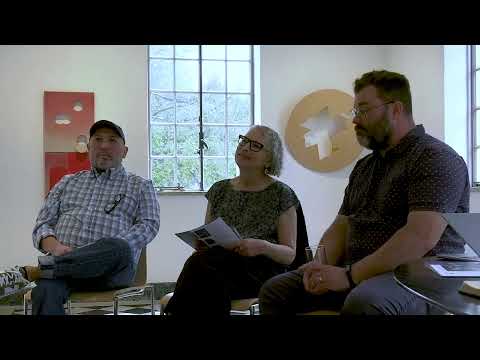
Brian Jones, director of Tristar Arts, opened a conversation in the gallery to introduce a two‑person exhibition the program is presenting this year and to frame the works as a conversation about space and objectness. He thanked funders, including the Tennessee Arts Commission and the More Hall Foundation, and said the exhibition list had been finalized and was ready to print.
One presenter, whose work in the room relies on stretched canvas and deliberate cut‑painting, described growing up in a family of women makers and said that early sewing practice shaped a desire to turn 2‑D surfaces into three‑dimensional objects. “My works are the stretched canvas works, primarily black and red up here,” she said, explaining that the series began as a feminist response to Kazimir Malevich and Russian constructivism and has evolved over 13 years.
The presenter outlined her studio technique in detail: she keeps sketchbooks, stretches linen, applies thin acrylic stains across the back and typically paints the front with one opaque coat. For most cut paintings she lays the work face down, marks cut lines in chalk, and cuts with a fresh X‑Acto blade; she said she sometimes fashions stencils from household objects and prays before starting delicate cuts. She noted there is one oil painting in the anteroom but said she shifted to acrylic for this series because oil cracked when the canvases were bent.
Alex Salides, the other artist in the show, described his practice as a sculptor and installation artist who flattens objects into two‑dimensional perspectives. He said some works grew from collecting images of tornado and hurricane damage and that he uses polygonal forms and a reductive, narrative approach to suggest both fragility and the built environment.
Both artists and Jones discussed installation choices—how armatures, frames, plexiglass and the direction of light affect a viewer’s ability to read color, depth and vulnerability in the pieces. The presenter said a key formal challenge is “how much can I remove before it falls apart,” balancing removal with the need to retain enough structure so a work endures.
The conversation also turned to process and how artists decide when a work is finished. Speakers emphasized practice and repeated making as ways to build the intuition to stop or rework pieces; “the work will take you on,” one speaker said. Salides addressed technology and digital tools, calling AI “a tool” he has tried to mock up color and scale in the studio while stressing he still values hands‑on making: “I don’t have a problem with AI. I tried it. I think it is a tool.”
Jones closed by reiterating practical exhibition details: the gallery has a finalized list of works ready for printing and the installation aims to play with scale and relational sightlines so viewers encounter surfaces that are at once familiar and resolutely material.