Get Full Government Meeting Transcripts, Videos, & Alerts Forever!
Get email alerts on the Budget And Housing topic
No spam. Unsubscribe anytime.
Council presses city on rollout of HOME housing plan, small‑business supports and proposed taxes
Summary
City planning and commerce officials told the Committee of the Whole they have begun deploying HOME bond dollars and small‑business JumpStart funds but council members demanded written operational timelines, district‑level data and clarity on who will cover program shortfalls and enforcement duties.
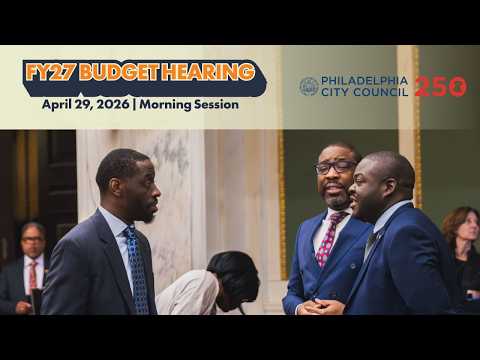
Philadelphia’s Committee of the Whole held a public hearing to review a package of fiscal‑year 2027 budget bills and the city’s forward‑looking HOME housing initiative, pressing department leaders for clearer timelines and more granular spending information.
The council hearing, convened by Council President Johnson, covered a set of ordinances that include proposed FY27 operating and capital budgets, a forward capital program and measures that would create or change local excise taxes (including a hotel occupancy tax proposal and a retail delivery tax). City officials from the Department of Commerce and the Department of Planning and Development (DPD) testified and answered extended questions from council members.
Why it matters: Council members repeatedly told department leaders that receiving bond or budget authority is only the first step; to actually deliver housing units, repairs and small‑business assistance the city needs firm operational plans and more transparent reporting so districts can track outcomes and protect residents from displacement.
Karen Fegley, acting commerce director, summarized Commerce’s FY26 accomplishments and FY27 priorities, saying the department remains “the economic catalyst for the city of Philadelphia” and that JumpStart small‑business assistance totaled $38,500,000 in the current cycle. Fegley told council the Mayor’s Business Action Team (MBAT) and Commerce programs have reached thousands of businesses with outreach, one‑on‑one assistance and grants, and that Commerce is updating grant applications and technical assistance to better serve very small and pop‑up entrepreneurs. “We are using some of what we’re calling JumpStart investment to support very small businesses,” she said.
Council members pressed Commerce on enforcement of storefront and window‑covering rules and asked how the department coordinates with Licenses & Inspections (L&I). Fegley said Commerce conducts corridor walks and educational outreach with L&I and offers incentive programs — including a storefront improvement program and design assistance — but emphasized that Commerce is not itself the enforcement agency. Councilmember Cindy Bass said follow‑up enforcement is inconsistent across neighborhoods and asked Commerce to partner more assertively with L&I so cited stores comply.
Jesse Lawrence, director of Planning & Development, testified on the HOME initiative and DPD’s FY27 operating plan, saying the department expects to advance a portfolio of housing and preservation programs that together target the creation or preservation of tens of thousands of units across multiple years. DPD described a FY27 production goal of roughly 3,900 new units in new construction, with about 1,900 multifamily units in predevelopment and roughly 1,500 under construction at the time of the hearing. Lawrence said DPD is coordinating with the Philadelphia Housing Development Corporation (PHDC) and the Land Bank to speed acquisitions and align RFP timing with state funding windows.
David Thomas, PHDC president and CEO, told council that basic systems repair (BSRP) wait times run about six to nine months depending on the scope of work and documentation; emergency repairs can be prioritized in as little as two months. Thomas said PHDC’s 6–9 month estimate reflects eligibility review, inspections and contractor scheduling, and that managers will raise a “red flag” if meeting income‑target goals becomes at risk.
Several council members urged faster operational plans and clearer public reporting. Councilmember Jamie Gauthier asked for a written cash‑flow and spending timeline for HOME funds, requesting district‑level reporting on how funds will be used and how long each program’s allotment is expected to last. Angela Brooks, chief housing and urban development officer, said HOME funds had just been received and that quarterly reports — which are required once spending begins — should start within roughly three months.
Concerns about displacement and fit with neighborhood incomes came up repeatedly. Councilmembers representing rapidly changing neighborhoods said Turn the Key and some solicitation processes have not produced proposals that match local AMIs. Lawrence and PHDC officials said Turn the Key has served households at or below roughly 60% AMI in prior rounds and pledged to provide more district‑level metrics and to work with council members on tailoring program tools to local needs.
Budget and program‑design specifics discussed at the hearing included: - Commerce said MBAT and technical assistance programs have reached thousands of businesses (MBAT ~3,300; business technical assistance ~921); JumpStart included grant and technical assistance pools. Exact counts of businesses that have drawn direct JumpStart dollars were not fully reported at the hearing and will be provided in writing. - DPD said its FY27 general‑fund request for planning and development work (exclusive of bond funds) was stated as roughly $30,000,000; Commerce referenced a FY27 general‑fund value of approximately $106,000,000 when excluding a $15,000,000 convention‑center subsidy. - PHDC reported an adaptive modification program waiting list just under 2,000 households and agreed to provide a breakdown of how many requests are for physical accessibility work. - Commerce and council discussed the Neighborhood Economic Development (NED) grant RFP, noting requests totaling about $11,000,000 versus available funding near $3,300,000; Commerce indicated it would consider raising storefront improvement caps from $15,000 to $30,000.
On financing and preservation, DPD and staff described a pending financing package for a PHA redevelopment (referred to in testimony as Bert Shalom): the city would guarantee a loan and contribute capital to leverage first‑mortgage financing being arranged by the building trades; officials said they would follow up on whether the guarantee requires a separate council action.
What’s next: Officials promised follow‑up materials, including (1) a written operational timeline and cash‑flow projection for key HOME‑funded programs, (2) district‑level reporting on housing outputs and HOME requisitions, (3) a breakdown of how JumpStart dollars have been spent and how many businesses have drawn direct aid, and (4) updated program reporting for PHDC wait lists and adaptive modifications. The committee recessed until the afternoon session.
Reporting note: Quotes and program numbers in this article come from departmental testimony at the March public hearing and from written figures cited by agency leaders during questioning. Where officials said figures were estimates or would be provided later, the story notes that follow‑up documentation was requested by council members.