Get Full Government Meeting Transcripts, Videos, & Alerts Forever!
Get email alerts on the Hospital Funding topic
No spam. Unsubscribe anytime.
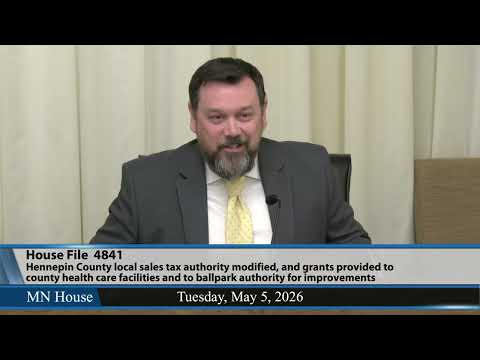
House tax panel hears $253 million sales-tax proposal to stabilize Hennepin Healthcare
Summary
Hennepin Healthcare officials told the House tax committee that the system faces an acute cash crisis and structural deficits, and Rep. Agbaje’s draft DE2 would combine a 0.7–0.75% local sales tax (estimated at $253 million) and general-fund stabilization grants while creating governance changes and a task force; members pressed for a detailed spending plan and debated alternatives.
The Minnesota House tax committee on May 5 heard Hennepin Healthcare and Hennepin County officials lay out an urgent funding and governance proposal to stabilize Hennepin County Medical Center (HCMC), a statewide safety‑net hospital facing rising uncompensated‑care costs and looming Medicaid changes.
Representative Agbaje presented a draft DE2 to House File 4841 that would blend a 0.7–0.75% extension of the local ballpark sales tax (estimated to raise about $253 million if it had been in place this year), general‑fund stabilization grants, and governance changes including a county‑established hospital board and a task force to study long‑term stability.
Why it matters: HCMC is a high‑acuity, academic safety‑net center that serves trauma, transplant and other specialty needs for the state. County and hospital officials said the facility’s payer mix and recent disruptions have pushed its finances toward a crisis that risks staff departures and reduced services.
Hennepin County Commissioner Jeffrey Lundy, chair of the Hennepin Healthcare System board, told the committee that "property taxes alone can no longer be the sole public investment" in the system and highlighted the county’s 2025 uncompensated‑care support of $38 million. He said the county had stepped in with short‑term cash support and other measures but that the scale of needs exceeded what local property taxes could sustainably shoulder.
John ******* , identified in the record as Hennepin Healthcare’s chief executive officer, described staff anxiety at the medical center and the risk to services if clinicians leave. "If we lose these people and or their spirit, we are in much greater trouble," he said, citing recent resignations and the sensitivity of subspecialty coverage for trauma accreditation.
Charles Esler, HCMC’s vice president of finance, reviewed payer‑mix charts showing uncompensated care rising as self‑pay moved from roughly 6% to 8% between 2020 and 2024. Esler told members that the shift contributed to about a $60 million annual increase in uncompensated‑care costs and warned that federal changes rolled into HR1 and anticipated Medicaid disenrollment will further reduce revenue beginning in 2027.
State Department of Health staff offered context on reporting and classification changes. Stefan Gildomiso, who directs MDH’s health‑economics program, said MDH has "limited insight into the composition of charity care" at hospitals and that a recent change in debt‑collection rules and an automated presumptive‑eligibility process have shifted some cases from bad debt into charity‑care reporting categories.
Committee members pressed Hennepin County and hospital leaders for specifics. Representative Robbins asked why the request had grown from a prior 0.15% proposal (about $54 million) to the draft that would raise roughly $253 million and repeatedly requested a line‑item budget showing how proposed funds would be spent. Commissioner Lundy and Representative Agbaje said more detailed allocations were available in slides and could be discussed further, but members said the packet lacked a clear, actionable budget breakdown.
Members also discussed alternatives to a sales tax: tapping unspent Met Council transit funds, reallocating existing local levies, or creating statewide stabilization grants that allow multiple hospitals to compete for support. Representative Freiberg urged including North Memorial in any relief so that multiple safety‑net providers could be supported; Representative Hewitt warned that using transportation funds risks infrastructure shortfalls.
Hospital and county witnesses described steps already taken: about 100 FTEs cut and roughly 100 beds temporarily closed to reduce expenses, repeated short‑term county lending (reported in testimony as about $30 million every two weeks to meet payroll), and capital‑preservation spending by the county. County staff estimated five‑year infrastructure needs at $310–375 million and presented an estimated new‑facility cost of about $1.3 billion plus $331 million in related projects to improve operational efficiency.
What’s next: Representative Agbaje emphasized the draft is informational and not being advanced in the committee that day. Committee leadership said the 1% proposal lacks the votes as drafted and urged rapid, creative work in the remaining days of session to blend options. The committee canceled its next scheduled meeting and adjourned.
Notes on procedure and action: the committee adopted the April 30 minutes by voice vote at the start of the meeting; no formal vote on any funding measure occurred during the hearing.
The tax committee hearing transcript names the presenters and many members of the committee and records multiple requests from legislators for a detailed spending plan before they will support a sales‑tax solution.