Get Full Government Meeting Transcripts, Videos, & Alerts Forever!
Get email alerts on the Animal Welfare topic
No spam. Unsubscribe anytime.
Montgomery County committee reviews Maddie’s Fund recommendations to shorten shelter stays and expand spay-neuter, TNR options
Summary
County animal services staff told the Public Safety Committee they have implemented many of the Maddie’s Million Pet Challenge recommendations and asked council to consider code changes on stray-hold length, trap-neuter-return for community cats, licensing and reclaim fees while planning staffing and budget follow-ups.
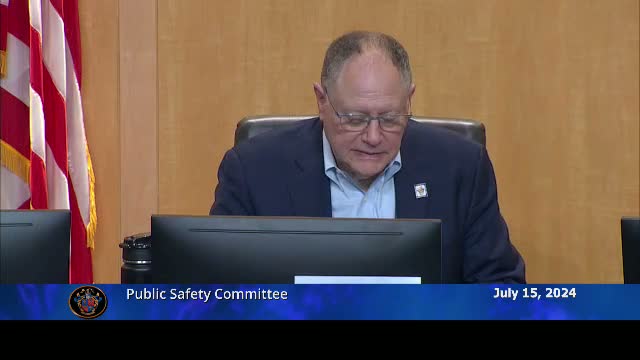
Commissioner Katz heard a presentation July 15 on a pro bono operational review from the Maddie’s Million Pet Challenge and a response from county shelter staff that laid out changes to reduce shelter crowding and speed adoptions.
Joseph Croupe, the staff presenter, summarized the consultant’s four policy recommendations: allow trap-neuter-return (TNR) for community cats, consider requiring veterinarians to sell pet licenses when providing rabies vaccinations, shorten the county’s five-day stray hold to align with the state-mandated 72 hours, and provide financial incentives or reduced reclaim fees tied to sterilization and microchipping. Croupe noted state law and county code could limit some options and asked the committee to direct county attorneys to clarify legal changes needed.
"You can't have it all," Dr. Sarah Pisano of Shelter USA said in describing the report’s approach to shelter flow, urging more community-based pathways such as TNR, fostering and transfer partnerships so shelters do not become default repositories for all animals. Pisano said such pathways reduce stress on animals and the shelter and are often more cost-effective than prolonged confinement.
Carolyn Herefield, executive director for Office of Learning Services and the shelter director who led implementation, described operational steps the Office of Animal Services has taken: reallocating vacant positions to add registered veterinary technicians, improving intake vaccination timing, launching finder-to-foster and foster-to-adopt pilots, expanding volunteer access and badges, and pursuing partnerships for on-site spay/neuter capacity.
Dr. Greg Lawrence, the shelter’s chief veterinarian, said adding veterinary staff and reorganizing into separate surgical and medical teams has sharply reduced the spay/neuter backlog and improved throughput. Lawrence reported the shelter historically performed about 1,800–1,900 surgeries a year and said the shelter aims to pilot a low-cost public spay/neuter clinic by year-end. He also described the recent canine-influenza response that affected about 55 animals and credited staff and volunteers for limiting the outbreak’s impact.
Committee members pressed staff for data to guide budget decisions. Council members asked for counts showing how diversion and foster programs changed intake and shelter inventories, and for clearer numbers on the operational impact of reallocating positions (for example, two dispatcher vacancies that reduced weekend OAS dispatch capacity and shifted calls to 911).
On policy specifics, staff and the consultant recommended exploring ordinance changes so community cats handled through TNR are managed as a spay/neuter pathway rather than as shelter intake because county code and state law currently limit some dispositions. The committee also discussed whether rabies clinics should be moved to a per-diem model while surgical backlogs are cleared, and whether the county should offer reduced reclaim fees or subsidized sterilization to remove financial barriers to reunification.
The panel debated volunteer background checks. Staff said background checks cost roughly $30,000 a year but that the shelter’s supervised volunteer model and facility security reduce risk; some council members said background checks remain prudent where volunteers access private homes or sensitive areas.
Director Herefield pushed back on a consultant recommendation to restrict nonemergency field responses to weekday hours, saying proactive, seven-day field presence reduces public-safety incidents and citing large increases in certain cases where enforcement was reduced in another jurisdiction. She urged caution before changing field-service hours that are currently available seven days a week.
The committee asked staff to: (1) provide specific metrics on spay/neuter throughput and diversion outcomes, (2) clarify legal constraints with the county attorney about stray-hold timing (business vs. calendar days) and TNR execution, (3) resubmit the consultant’s redlined ordinance revisions for review, and (4) quantify staffing and operational impacts of reallocations to inform the next budget cycle. The meeting adjourned with no formal vote on ordinance changes; staff will return with follow-up information.