Steering Committee orders technical workshop after confusion over new housing-allocation method
Summary
Public commenters and local officials pressed Spokane County staff to resolve confusion about recently adopted housing-allocation calculations — a change staff says resulted from evolving Commerce/HAT tool methodology — and staff promised an April technical workshop and a May briefing to the Board of County Commissioners. The committee adopted minutes by voice vote and will return with a reconciliation memo.
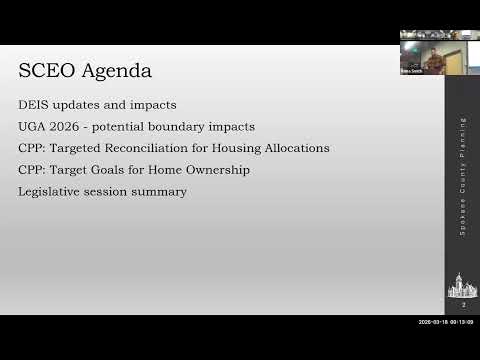
On March 18, the Spokane County Steering Committee of Elected Officials heard sustained public concern about recent changes to countywide housing allocations and directed staff to convene a technical workshop to reconcile how those numbers were produced.
The debate centered on a shift in how allocations were calculated after staff used a method the county labeled “A‑prime,” which Commerce now calls method C. Darren Watkins, representing Spokane Realtors, told the committee the adapted numbers were being “adapted even lower” and warned, “you are in a border war and are losing badly,” urging a reexamination of the targets presented to jurisdictions.
Peter Hagan, land acquisition manager for Hayden Homes, said the revision “shifts approximately 6,000 housing units away from areas with demonstrated capacity for growth and into locations that face significant development constraints,” and asked the steering committee to reaffirm the originally calculated allocations that PTAC and the Board of County Commissioners had recommended earlier.
Multiple speakers — including Jim Brady of Greenstone Corporation and other home‑building and neighborhood representatives — said the change introduced uncertainty for jurisdictional planning and could conflict with countywide planning policies and Growth Management Act (GMA) principles that favor directing growth into areas with infrastructure and services.
State planning staff sought to clarify the technical roots of the change. Melissa Tuley, a senior planner with Commerce’s Eastern regional team, said Commerce developed an alternative methodology (now called method C) to better account for unincorporated and rural UGA areas; she confirmed county references to A‑prime are effectively Commerce’s C. County staff and consultants acknowledged the HAT/HAP tool’s evolution and the difficulty jurisdictions had in interpreting the algorithm that translated population inputs into housing allocations.
County staff told the committee they will convene a focused technical workshop in April to walk jurisdictions and PTAC through the HAT inputs and the specific tables used by the county and cities, and they plan to brief the Board of County Commissioners ahead of May materials. Staff framed reconciliation as a practical path that can revisit allocations without reopening every EIS immediately, given many jurisdictions have already advanced plan work.
Airway Heights Mayor Larry Bowman urged that the city’s unique constraints — including Fairchild Air Force Base, flight restrictions and water supply issues — be respected and that any allocation adjustments be feasible for the jurisdiction. Scott Chesney, county planning staff, said the county will circulate memos and a five‑step reconciliation proposal before returning to the steering committee in May.
Votes at a glance: The committee adopted the Feb. 11, 2026 minutes by voice vote; the transcript records the motion, a second and an oral “aye” vote but does not record a roll‑call tally.
What’s next: Staff will survey jurisdictions to schedule an April technical workshop and will return to the steering committee with a reconciliation memo and proposed countywide planning policy amendment for further public hearings and PTAC review.
AI generated
The text on this page is AI generated. Summaries, highlights, analysis, and video transcripts are all produced from the original source material.
AI can make mistakes, so if you spot one, and we will fix it for everyone.
Note: the source content is unaltered by us. Any content source we link to, be it a video, an audio recording, or a document, is presented exactly as its publisher released it. That publisher is usually a government body, sometimes an individual official or another organisation.