Get Full Government Meeting Transcripts, Videos, & Alerts Forever!
Get email alerts on the Surveillance Technology Policy topic
No spam. Unsubscribe anytime.
Board to agendize generative AI review; commenter urges ban on facial recognition as VPD explains audit tools
Summary
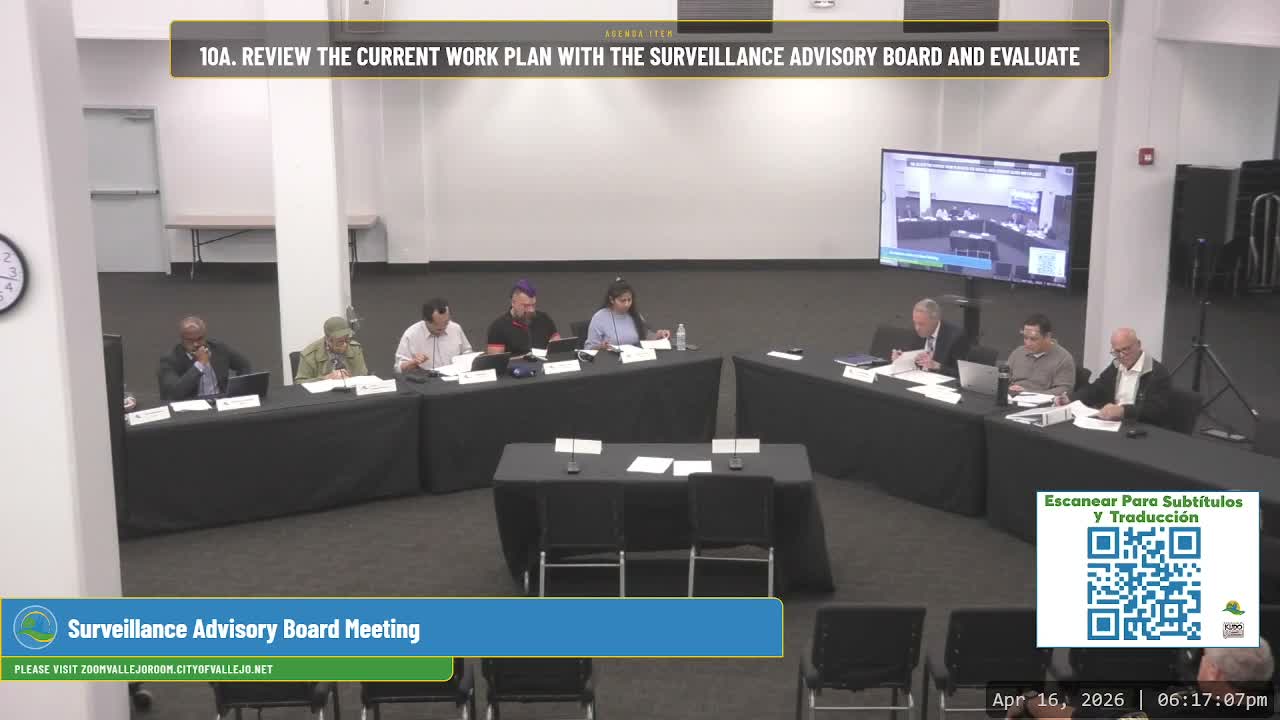
The Vallejo board voted to agendize a review of generative AI and AI-enabled features for future meetings. Public commenter Jose Carrizales urged opposition to facial recognition citing wrongful arrests and bias, while Captain Catherine Bautista of the Vallejo Police Department said Flock supplied audit-capability materials but the department has not yet run audits.
The Surveillance Advisory Board voted to place a review of generative AI and AI-enabled analytical tools on a future meeting agenda, asking staff and the audit ad hoc committee to examine whether software upgrades that add AI capabilities constitute material changes requiring board review.
Board member (speaker 4) introduced Item B, saying generative AI is increasingly embedded in surveillance-related products and asking whether such feature upgrades should trigger board oversight. A motion to agendize Item B for the next meeting passed on a roll-call vote.
During Item C and community forum, public commenter Jose Carrizales addressed the board and strongly opposed the use of facial recognition technology. Carrizales said the technology has led to wrongful arrests and disproportionate false-match rates for people of color, women, youth and elderly people; he urged the board to consider the consequences for Vallejo residents and questioned whether increased access to surveillance tools would erode trust. Carrizales said, “I strongly oppose the use of facial recognition... Facial recognition technology often produces false matches,” and referenced published incidents and studies he said showed bias and wrongful outcomes.
Captain Catherine Bautista of the Vallejo Police Department responded during the media-article and technology-use portion of the meeting. She said she had shared vendor-provided articles and an FAQ from Flock to explain capabilities and safeguards, and confirmed the department has auditing capabilities available in its Flock system but has not yet conducted an independent audit of Flock usage. Bautista said the vendor’s materials are public-facing and were shared to give the board information “at your fingertips.” She also said the department uses administrative and regular user accounts for the system and that audit logs exist, but that auditing has not been run in practice.
Board members asked about proof-of-concept testing and auditing timelines. A member of the police tech team, Sergeant Abeyta, explained the enterprise drone’s FLIR (thermal) capability and how it supports night operations and hotspot detection; Abeyta said the Raven gunshot-detection system had a one-year beta trial but the department did not conduct a formal audit during that trial.
The board voted to agendize a facial-recognition policy discussion for a future meeting after the public comment. Members also urged the police department to consider putting in place interim auditing practices that could inform the board’s eventual comprehensive audit policy.
The board will consider Item B (AI) and Item C (facial recognition) at a future meeting and directed staff to share relevant draft citywide AI policy documents with the board when available.