Get Full Government Meeting Transcripts, Videos, & Alerts Forever!
Get email alerts on the Public Works topic
No spam. Unsubscribe anytime.
South Bend public works outlines leaf pickup, paving and curb/sidewalk programs; pacing set for April–November
Summary
Public Works Director Eric Corvoth told the Common Council the city resumed leaf pickup March 23 and expects to finish the full second pass by April 23; milling for the annual paving program is planned to begin April 27 on roughly 50 streets totaling about 41 lane miles. The presentation also covered curb/sidewalk reimbursements, school‑sidewalk grant work and traffic‑calming limits.
Public Works Director Eric Corvoth briefed the South Bend Common Council on April 13 on seasonal operations and capital work, saying leaf pickup resumed March 23 and the crews expect to complete a full second pass of the city by April 23 so they can begin milling and paving work.
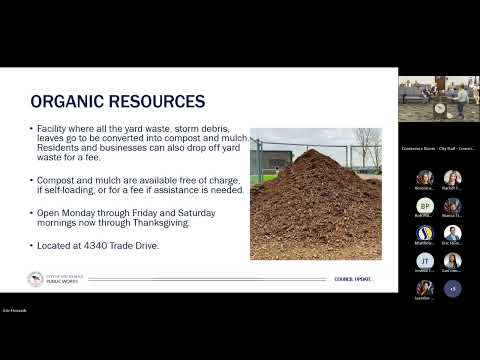
Corvoth said the city restarted leaf pickup in the zone where crews had stopped last fall and is ‘‘getting pretty close’’ to completing two full rounds. He described the yard‑waste program, which began March 30, as a weekly pickup provided through a brown‑bin subscription (about $6 per month during the eight‑month season). Corvoth added that yard waste and leaves are taken to the city’s Organic Resources facility north of the airport for processing into wood chips and compost. "If you load it yourself, you can pick compost or wood chips up for free," he said.
The update included a schedule for paving: hot‑mix pothole patching is underway and the city plans to begin milling April 27, with a paving program that will target roughly 50 streets (about 41 lane miles). Corvoth said residents can view the paving map and the pavement condition index (PCI) online at southbendin.gov to see which segments are scheduled, in progress or complete. "We'll start milling April 27 and start our paving program," he said.
Corvoth described several larger projects: Ireland Road work will add a turn lane at Fellows and keep at least one lane open during construction with completion expected by the end of June; the KFax/East Bank streetscape will add a multi‑use path, elevated crossings at Sycamore and Niles, decorative lighting, benches and new trees and will be phased with an anticipated completion by November. He noted some underground storm and water work will extend that project’s timeline.
On sidewalks and curbs, Corvoth outlined two programs: a council allocation program that funds council‑directed projects and a reimbursement program in which homeowners (and commercial property owners at a lower rate) pay contractors up front and receive reimbursement afterward. He said the city uses three rotating target areas to concentrate higher reimbursement rates based on income qualifications; ADA corner/ramp reimbursements were cited at $950. "You sign up, get the work done, and then we measure it and pay you back," he said.
Corvoth also summarized a federally funded school‑sidewalk grant (an 80/20 match) that will fund roughly 3.25 miles of sidewalks and about 60 ADA ramps near Meisel and Kennedy Academy; he said the city’s 20% match was covered and the work is expected to be completed in August.
Regarding alleys, Corvoth said the city moved to a quadrant‑by‑quadrant alley grading schedule beginning in May and running through November to improve efficiency; residents should report specific alley issues to 311. Corvoth explained that illegal dumping and alley cleanups are handled by Neighborhood Services/Enforcement while forestry handles pruning and brush clearing.
On traffic calming, Corvoth said the city has received about 450 distinct requests since 2018 but has funding to install roughly 12 new speed humps per year; there are currently about 120–130 concrete speed humps in the city and roughly 20 older rubber humps that have not held up. He described the prioritization process—using traffic volumes, pedestrian and bicycle counts, crash history, measured vehicle speeds and proximity to schools and parks—and said traffic enforcement by the police department supplements engineering measures.
Council members asked follow‑up questions about notification timing for curb/sidewalk construction, enforcement and response to illegal dumping in specific alleys, and beautification options for viaducts; Corvoth and staff committed to follow up with emails and to provide the presentation materials on request. The briefing closed with council members thanking the director and staff.
The city asked residents to check southbendin.gov for the paving map and PCI details and to report alley and dumping issues through 311.