Get Full Government Meeting Transcripts, Videos, & Alerts Forever!
Get email alerts on the Education Assessment topic
No spam. Unsubscribe anytime.
Somerville board hears midyear progress: K–5 proficiency up, district to re-run climate survey
Summary
Somerville administrators reported midyear gains on K–5 reading and math benchmarks and outlined next steps to use a New Jersey school‑climate survey to guide school-level improvements; board members pressed for subgroup breakdowns and participation rates.
Somerville — Administrators told the Somerville Board of Education that midyear assessment data show meaningful progress in early grades and that a districtwide climate survey will be used to guide school-level changes.
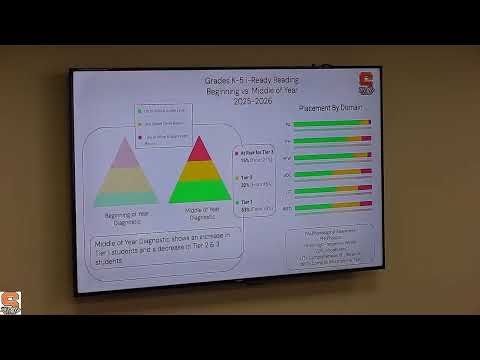
Mary Kaine, a district presenter, said K–5 on‑or‑above grade‑level rates rose by about 20 percentage points from the start of the year to midyear on the I‑Ready and classroom observation measures, and that students one grade below decreased roughly 13 percentage points while students two or more grades below dropped about 6 points. At the middle‑school level, presenters reported roughly an 8‑point gain in reading and math on comparable measures.
Those gains, Kaine said, reflect a combination of observational preschool data, I‑Ready diagnostic growth, data‑driven coaching and newly adopted pacing guides. "Wehave grown our number of students who are on or above grade level by 20 percentage points K to 5," Kaine said, describing the districtapproach to tiered supports and teacher coaching.
The presentation also outlined tools and routines the district is using: classroom observational data for preschool, I‑Ready K–8 benchmarks, LinkIt assessments at the high school and centralized data teams that run "data chats" with teachers and administrators to target instruction.
Board members asked for subgroup disaggregation and accommodations. Kaine said the district can disaggregate by cohort and that ESL teachers and building administrators review language accommodations individually; she confirmed that Spanish‑language testing options are considered where needed.
On climate and culture, Dr. Fuentes and Dr. McDonald summarized administration of the New Jersey School Climate Improvement Survey in November using the NJ Sky (Ruckers) platform. The survey covers 13 domains including sense of belonging, academic culture, student voice and physical safety, and was administered to students in grades 3–12 during the school day and to staff and parents in open windows.
Dr. McDonald said school‑based teams are now reviewing the data and will make targeted adjustments to social‑emotional supports and programming. The district plans to re‑administer the survey at the end of the year to measure change and to guide next‑year planning.
Board members pressed for response‑rate detail. Presenters reported approximate participation counts: the high school had about 50% student participation along with 78 staff and 90 parent responses; the middle school had 294 student respondents, 48 staff and 67 parents; Vandervir had 268 students, 72 staff and 106 parents. Presenters confirmed the survey responses are anonymous.
Why it matters: The midyear check gives the board and public a snapshot of progress toward the districtgoals for the year and identifies where targeted interventions or professional development might be needed.
Next steps: The district will use Friday professional development time to dig deeper into I‑Ready and LinkIt results and will report back to the board after school‑based committees review the climate survey findings. The board also plans a summer reflection on the yearend and next steps.