Get Full Government Meeting Transcripts, Videos, & Alerts Forever!
Get email alerts on the Short Term Rentals topic
No spam. Unsubscribe anytime.
Santa Barbara committee weighs strict short‑term rental rules amid split public testimony; hearing continued
Summary
City staff presented a draft short‑term rental ordinance that would restrict coastal and inland STR uses, impose parking and inspection requirements, require platform disclosure (citing SB 346), and limit who may hold licenses. Dozens of residents, operators and business groups gave strongly opposed views; the committee continued the matter to a future meeting.
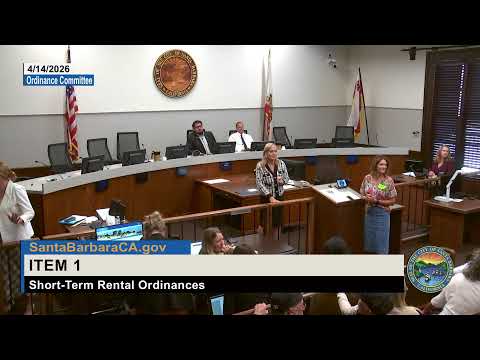
City staff outlined a proposed short‑term rental ordinance on Tuesday that would create licensing areas, set on‑site parking and inspection standards, limit eligibility for licenses and require platforms to display city permits — and then spent more than an hour fielding sharply divided public comment.
The committee hearing, led by President Gutiérrez, focused on two parallel code changes: amendments to the inland zoning code (Title 30) and the coastal zoning code (Title 28). Staff said the draft aims to provide “a simple, reliable permitting process” and enforcement tools to address neighborhood nuisance and compatibility concerns while allowing limited shared‑housing options and a defined coastal license area.
Staff planner Loy told the committee the ordinance would generally require two on‑site parking spaces (three for very large units), a pre‑licensing inspection, documentation of ownership and management, insurance and performance standards for noise and parking. The draft would bar accessory dwelling units and units subject to recorded affordable‑housing covenants from obtaining STR licenses, and it would assign licenses to individuals (non‑transferable under the current draft). City attorney Ariel and staff also referenced SB 346 (2025) as giving local governments additional authority to require platforms to disclose listings and permit data.
The presentation included local counts and revenue figures: staff cited roughly $2.8 million in transient‑occupancy tax (TOT) receipts tied to STRs in fiscal 2024 and said collections stood at about $2.7 million as of late January 2026; staff also said 255 coastal units currently pay TOT and roughly two dozen inland properties had converted through a change‑of‑use process.
Public comment split sharply. Mesa resident Jack Senawer urged the committee to adopt the ordinance as drafted to preserve neighborhood character and prevent unlicensed commercial operations in residential areas. By contrast, industry representatives and hospitality firms — including Katy Diques, president and CEO of Visit Santa Barbara — asked for more study of visitor behavior and fiscal impacts, saying STR guests do not necessarily convert to hotel stays and warning that TOT revenue and local jobs could decline if the ordinance eliminates a large share of existing STRs.
Licensed operators asked for clearer grandfathering and transfer rules. One operator, Kelly Ari of Team Management LLC, said the draft’s non‑transferable license language would harm family businesses and asked for longer cure periods and reconsideration of the city’s proposed insurance and indemnity requirements.
Several speakers, including the chair of the Planning Commission, recommended staff study alternative allocation systems such as citywide caps or a lottery model rather than the zoning‑based approach in the current draft. Multiple residents raised safety concerns, particularly in high fire‑hazard coastal neighborhoods, arguing stricter limits or outright prohibitions are justified in those locations.
The committee did not take final action on the ordinance. Chair Gutiérrez moved — and Interim Mayor Esnedon seconded — a motion to continue the hearing to the committee’s next meeting; the motion passed unanimously. Staff said the item will return to the Council for presentation and possible approval in May and that the coastal amendment would be transmitted to the California Coastal Commission later in the summer.