Get email alerts on the Procurement topic
No spam. Unsubscribe anytime.
Carroll County interviews three finalists for $60M sheriff’s office and jail modernization project
Summary
Carroll County commissioners heard 20‑minute pitches from three construction teams — McCarthy Barnsley, Raylin (with SG Contracting), and Carol Daniel/RKR — each promising to meet a fixed $60 million budget, limited scope including female housing and 66 medical/mental‑health beds, and a tight schedule timed to open in fall 2028.
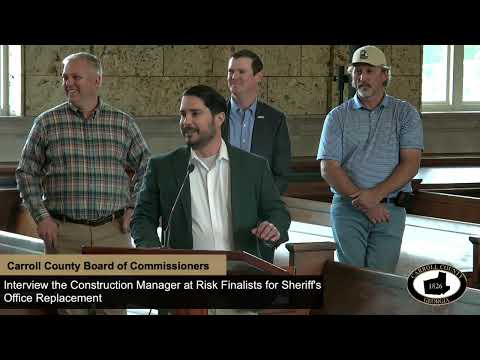
Carroll County commissioners on Monday interviewed three finalists for the construction‑manager‑at‑risk contract to deliver a new sheriff’s administration building, a female housing addition and medical/mental‑health housing and related renovations.
The county’s RFP sets a $60 million budget described repeatedly by all three firms as non‑negotiable and asks bidders to integrate the new buildings with the existing secure facility while keeping that facility operational. No formal award or vote occurred at the session.
McCarthy Barnsley framed its pitch around three pillars: the fixed $60 million budget, a non‑negotiable program that includes female housing and 66 medical/mental‑health beds, and an August 2028 opening target. “We’ve got a $60 million budget and that budget’s not negotiable,” said Rob Schultton of McCarthy Barnsley, who emphasized specialty market relationships for detention locks and modular cell manufacturers to meet the schedule.
Raylin’s pitch emphasized local participation and transparency. Ben of Raylin said the firm employs about 130 people in Carroll County and that early engagement with local subcontractors and prefabrication helped the company meet tight schedules on comparable projects. Raylin also described an ‘‘open‑book’’ cost approach intended to give the county real‑time budget visibility.
Carol Daniel paired with RKR to highlight a large pre‑construction bench and building‑information‑modeling (BIM) clash detection as tools to reduce late surprises. The team pointed to recent occupied‑site projects in the region and described daily tool‑control checks and site‑specific safety plans to prevent contraband during work adjacent to an active jail.
Commissioners’ questions focused on three recurrent themes: how CM‑at‑risk differs from other delivery models, how bidders will catch design or constructibility issues early (weekly model reviews, constructibility checks and Procore documentation were cited), and how firms will control risk adjacent to the active jail (background checks, daily tool logs and isolation of the work zone).
None of the finalists asked the board for extra time to negotiate contract terms; each said it could enter pre‑construction quickly if selected, and each indicated openness to discuss fee methodology. The meeting closed for transition to the next group; the board did not vote on an award in this session.
AI generated
The text on this page is AI generated. Summaries, highlights, analysis, and video transcripts are all produced from the original source material.
AI can make mistakes, so if you spot one, and we will fix it for everyone.
Note: the source content is unaltered by us. Any content source we link to, be it a video, an audio recording, or a document, is presented exactly as its publisher released it. That publisher is usually a government body, sometimes an individual official or another organisation.