Get Full Government Meeting Transcripts, Videos, & Alerts Forever!
Get email alerts on the Nonmetallic Mine topic
No spam. Unsubscribe anytime.
Dodge County panel approves preliminary permit for 223‑acre limestone quarry despite residents' health and road concerns
Summary
The Dodge County Land Resources and Parks Committee granted preliminary approval Jan. 12 for a conditional use permit to establish a 223.4‑acre nonmetallic (limestone) mine in the Town of Trenton. Neighbors urged denial, citing water contamination, dust, blasting and road damage; the committee imposed 19 conditions and negotiated setbacks and road‑maintenance agreements.
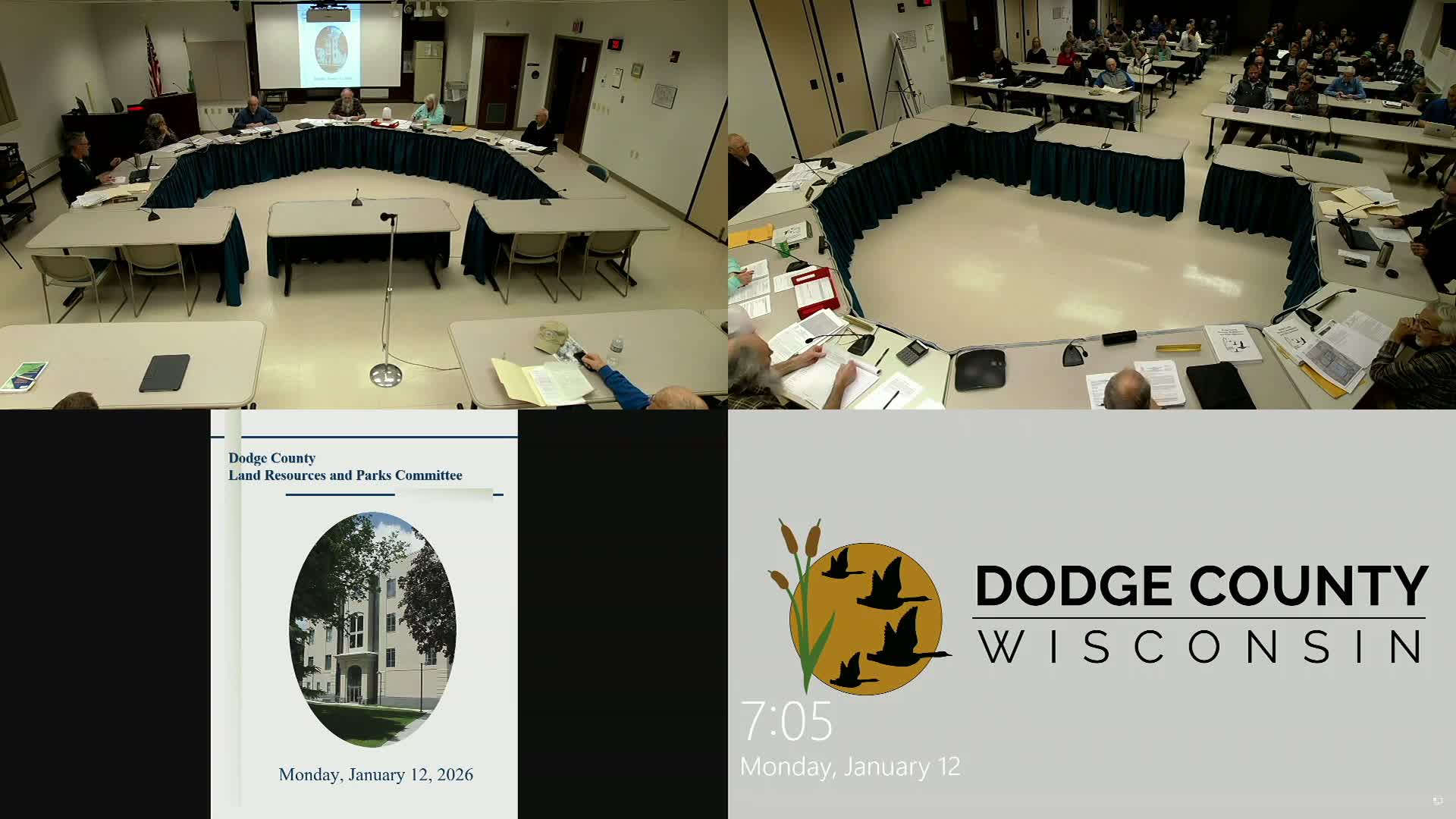
The Dodge County Land Resources and Parks Committee on Jan. 12 granted preliminary approval for a conditional use permit that would allow the creation of a 223.4‑acre nonmetallic (limestone) mine in the Town of Trenton.
County staff read a detailed application and recommended conditions tied to the Dodge County Land Use Code and Wisconsin statutes, including requirements for erosion control, reclamation plans, financial assurance and limits on blasting and crushing hours. The staff report described initial mining on roughly 10 acres, use of portable crushers and screens, an on‑site scale house and a projected annual production of about 50,000–100,000 tons.
The applicant, Michael Karteshner, told the committee the mine would begin near County Road A and expand as market demand grows. "Just essentially that, yeah, we're looking to, develop a non metallic mine here," he said, and offered to do pre‑blast surveys and negotiate hours and berm placement to reduce impacts near houses.
But many nearby residents urged the committee to deny the permit. Smiley Kosinski, who said he lives on Spruce Road, told the panel he and neighbors have documented road damage, increased dust and what he described as contamination of creek water: "They are poisoning our water and they have shown that they cannot be trusted," Kosinski said, adding that prior testing had found arsenic in a creek he linked to quarry blasting. Other speakers described structural vibration, cracked plaster and safety hazards from gravel on roads, and urged baseline water testing, stronger enforcement and tighter setbacks.
Committee members repeatedly returned to the legal standard they must apply. One member summarized the constraint: the state standard requires "substantial evidence" to deny a conditional use permit, meaning factual proof rather than preference; staff told the committee the 19 draft conditions could be tailored to address site‑specific concerns.
After discussion the committee amended several draft conditions to clarify setbacks near residences, hours of operation, blasting windows and road‑maintenance agreements. The committee agreed to a framework that maintains 100‑foot setbacks around residences while allowing tighter setbacks elsewhere when accompanied by berm placement and protections; it also required documentation that the applicant will enter contracts to maintain the portions of Breezy Point Road and other local roads used by quarry traffic prior to permit issuance.
The committee voted to grant preliminary approval of the conditional use permit subject to the amended conditions; the motion carried with one recorded abstention (Dale). The Land Use Administrator was directed to issue a conditional use permit incorporating the committee's decisions.
What happens next: The approval is preliminary and conditioned on the applicant meeting the permit requirements, including any required town or county access and maintenance agreements, DNR permits and a reclamation permit consistent with the county's nonmetallic mining reclamation ordinance. Appeals may be filed in accordance with the county procedure and state statute.