Get email alerts on the Wildfire Resiliency Code topic
No spam. Unsubscribe anytime.
Pitkin County staff outline CWRC implementation, say code takes effect May 2
Summary
Pitkin County community development staff walked property owners, designers and builders through how the Colorado Wildfire Resiliency Code (CWRC) will be applied locally, explaining that intake/accepted permit dates determine which code applies and that May 2 is the county’s in‑effect date.
Pitkin County community development officials on a webinar said the county-adopted Colorado Wildfire Resiliency Code will take effect May 2 after an April 2 adoption notice, and they urged applicants to check intake/accepted dates to determine which rules apply.
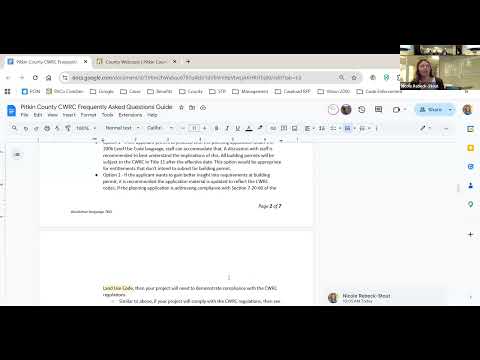
"We publicly noticed the adoption on April 2 and so with a 30‑day noticing the code will be in effect on May 2," said Nicole Reebeck Stout, deputy director of community development, who led the webinar. She directed designers and property owners to the county’s active projects webpage and a forthcoming FAQ guide for implementation resources.
The webinar focused on practical steps for projects at different stages. Staff said that a vested land‑use approval does not by itself exempt a project from the CWRC: if a project has not been accepted into the building permit intake process, the CWRC’s building rules will apply at permit time. "Even if you have a vested approval, if you are not in for a building permit then you will need to comply with the CWRC building code," Reebeck Stout said.
Chief building official Jeffrey Ericson and building supervisor John Hton walked through how the county will treat three common scenarios: pre‑application summaries, planning applications deemed complete before the in‑effect date, and approved land‑use cases with no building permit. They said applicants who plan to submit for building permits are best served by coordinating with planners early to establish a fire intensity classification or to prepare ground‑truthing reports when site conditions differ from mapped values.
Ericson emphasized that code applicability will be determined by the intake/"intake accepted" date recorded in the county’s Sages permit system, not by the initial submission date. "If it was intake accepted May 1, then you would be on the 2006 land use code," he said. Staff said they will ensure Sages records both submitted and intake‑accepted dates to reduce confusion.
On mapping, county staff said the GIS product integrating the county and state wildfire maps will be available via the active projects page; after May 2 the previous wildfire hazard map maintained on Maps and More will no longer control applicability. Staff reiterated that anyone may author a ground‑truthing report but that fire districts will determine whether to accept it, in whole or in part.
The presentation also covered technical compliance points: additions greater than 500 square feet will be treated as new construction under the CWRC; alterations that affect 25% or more of an exterior wall assembly or roof trigger full assembly compliance; and untreated wood siding is not permitted for exterior siding where the code requires fire‑retardant treatment. "It has to be treated at the manufacturer," John Hton said, noting field‑applied treatments do not meet the code definition. Plan reviewers will typically require manufacturer cut sheets or equivalent test documentation to verify compliance.
Staff described the roles of reviewers: development review planners will handle planning applications and exemption letters (usually with fire‑district referrals), zoning planners will review site and area plans for permit compliance, and fire districts will be primary reviewers for ground‑truthing and modification requests.
The county will post a recording of the webinar and a living FAQ guide on the Community Development active projects page later in the week, staff said, and encouraged applicants to contact the assigned planner or use the planner/builder of the day emails for follow‑up questions.
Next steps: the CWRC becomes effective May 2; applicants should confirm intake/accepted dates in Sages to determine which code applies, prepare manufacturer documentation for materials that must meet fire‑resistance criteria, and consult planners early if they expect to seek ground‑truthing or exemptions.
AI generated
The text on this page is AI generated. Summaries, highlights, analysis, and video transcripts are all produced from the original source material.
AI can make mistakes, so if you spot one, and we will fix it for everyone.
Note: the source content is unaltered by us. Any content source we link to, be it a video, an audio recording, or a document, is presented exactly as its publisher released it. That publisher is usually a government body, sometimes an individual official or another organisation.