Commission agrees to study tenants-rights options, forms small study group
Summary
After an extended work session, Mount Pleasant commissioners agreed to convene a small study committee of commissioners and staff to draft recommendations on tenant-rights tools, resources and possible policy changes; commissioners emphasized advisory scope rather than adjudicating individual disputes.
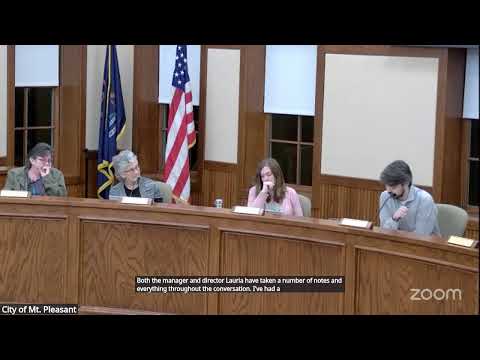
The Mount Pleasant City Commission continued a work session on tenants-rights policy on March 9, focusing on whether to establish a standing advisory committee to address tenant issues and recommend policy changes.
Public Safety Director Paul Lauria and City Manager Desense said existing town–university liaison efforts address some neighbor disputes but do not substitute for broader tenant-policy guidance. Commissioners and members of the public described common problems, including unclear tenant rights, maintenance complaints, and large landlords' practices. Several residents and landlords spoke during public comment; one landlord recommended starting with a refreshed quarterly meeting structure, while tenants urged proactive policy changes to reduce homelessness and improve repair processes.
Commission discussion focused on scope: many commissioners emphasized that a committee should be advisory — consolidating information, recommending ordinances (for example, right-to-repair practices or eviction-time limitations), monitoring trends and producing regular reports — rather than serving as an adjudicatory body that would resolve contract disputes. Director Lauria clarified that the city cannot provide legal advice and that many landlord–tenant issues remain contractual and are handled by courts or through state programs.
Commissioners agreed to appoint a small study committee of commissioners and staff to develop a more detailed charge and membership proposal. Several commissioners volunteered to serve on that study committee; the mayor said appointments would be announced as part of a future agenda and staff would help coordinate follow-up work.
The commission framed the study committee as a step to gather resources, evaluate state programs and local data, and produce concrete recommendations for whether and how to form a standing tenants-rights advisory board.
AI generated
The text on this page is AI generated. Summaries, highlights, analysis, and video transcripts are all produced from the original source material.
AI can make mistakes, so if you spot one, and we will fix it for everyone.
Note: the source content is unaltered by us. Any content source we link to, be it a video, an audio recording, or a document, is presented exactly as its publisher released it. That publisher is usually a government body, sometimes an individual official or another organisation.