Get Full Government Meeting Transcripts, Videos, & Alerts Forever!
Get email alerts on the Interim Rates topic
No spam. Unsubscribe anytime.
Committee hears arguments for and against capping interim utility rate increases at 5%
Summary
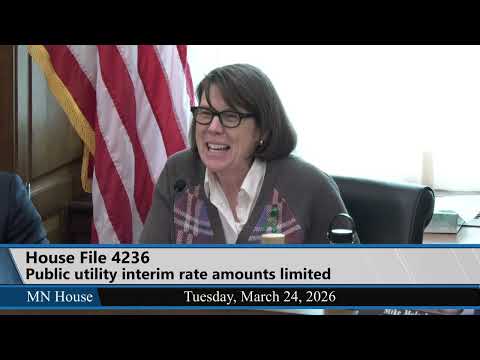
The House Energy, Finance and Policy Committee heard competing testimony on House file 42 36, a bill that would cap interim utility rate increases at 5%. Commerce and the PUC backed the cap as a consumer protection measure; utilities warned of unintended financial and reliability consequences. The bill was laid over.
The House Energy, Finance and Policy Committee heard testimony on House file 42 36, a proposal to limit interim utility rate increases to 5%, with backers saying the cap would protect customers from lengthy overpayments and opponents arguing it would shift costs and raise long-term rates.
Deputy Commissioner Pete Wyckoff of the Minnesota Department of Commerce told the committee that interim rates — automatic, statutory increases utilities may collect while a formal rate case is pending — can produce substantial short-term charges for captive customers. "What this bill does is simple and long overdue. It will cap interim rate increases at no more than 5%," Wyckoff said, urging the committee to support the change to reduce what he described as de facto loans from ratepayers to investor-owned utilities.
Mike Bull, deputy executive secretary of the Minnesota Public Utilities Commission, said the commission shares commerce’s affordability concerns. "Interim rates can go into effect without analysis by the parties or approval by the commission," Bull said, and recommended reform to reduce the burden on customers while the commission completes its review.
Utility representatives and stakeholders cautioned the committee about unintended consequences. A representative for Otter Tail Power said capping interim rates could force smaller utilities to file rate cases more frequently, raising administrative costs that would be borne by customers. "Limited interim rate increases will likely result in more frequent rate-case filings," the witness warned.
Jennifer KTM, vice president of public policy and external affairs for Minnesota Power, emphasized utilities’ long-term capital planning and said an arbitrary cap could harm credit metrics and the sector’s ability to finance investments. Al Crew, vice president for state and regulatory policy at Xcel Energy, said capping interim rates would not make energy more affordable in the long run and could reduce time for regulators to evaluate requests.
Eric Swanson, counsel for CenterPoint Energy, described the statute’s history and the safeguards in place, including refunds with interest when final rates are lower than interim rates. He noted refunds have been modest: in CenterPoint’s last case, the company paid an interest-adjusted refund that averaged less than $5 per customer.
Committee members pressed witnesses on details. Commerce staff said the interim-rate interest is set by Minnesota rule and currently uses the average prime rate; Commerce also said the 5% cap reflects the average actual increase observed in the cases it reviewed and that its analysts showed modest per-customer savings in recent cases.
No final vote was taken on the underlying policy; members laid the bill over for possible inclusion.
The committee’s next meeting was announced at the close of the session.