Get Full Government Meeting Transcripts, Videos, & Alerts Forever!
Get email alerts on the Education Computerscience topic
No spam. Unsubscribe anytime.
Weston updates K–12 computer science plan as state revises standards
Summary
Weston staff told the Curriculum Subcommittee their districtwide K–12 computer science plan has been drafted and submitted to the state; staff flagged reporting discrepancies on participation, urged professional learning and cross-curricular integration, and said further changes will follow state-standard revisions this summer.
Beth Lancaster, Weston Public Schools’ secondary curriculum and instruction leader for science and technology, told the Curriculum Subcommittee the district formed a K–12 computer science committee in 2024–25, completed a crosswalk of existing curricula and drafted a plan that was submitted to the state department.
Lancaster said the committee grounded its work in computer science standards and identified a K–5 and 6–12 pathway, teacher pipeline needs, and professional development priorities. She said the Computer Science Teachers Association released draft revised standards this fall and the state will review new standards for adoption this summer, so Weston has paused major implementation steps pending that process.
Lancaster also flagged a reporting issue: state data list 9.8% participation in computer-science courses for Weston, but district staff told the board they are reviewing whether some "group two" courses with integrated computer-science content (for example, PLTW digital electronics or engineering-design courses) should be counted differently. "We’re working on that and making sure we’re accurately reporting what we offer," Lancaster said.
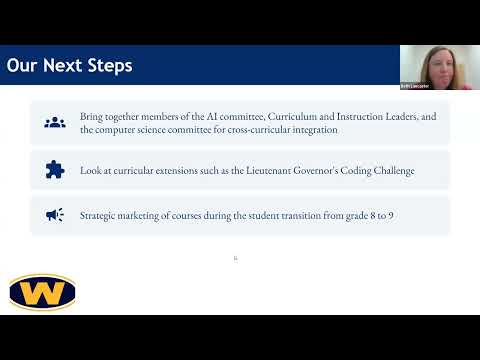
Board members asked about alternating course offerings and scheduling constraints that limit students’ ability to enroll. Trustees urged stronger marketing at key transition points (grade 8→9) and more outreach to girls in STEM; one member suggested highlighting computer-science work at the district’s May project showcase. Lancaster said professional learning for teachers and partnerships for dual or concurrent enrollment (with local community colleges) are central to scaling access.
What happens next: staff will continue cross-curricular planning, expand professional learning, and follow the state’s review of updated standards before making major implementation changes. The district also plans to verify course classifications with the state so participation statistics reflect courses with embedded computer-science content.
The presentation was part of a broader Curriculum Subcommittee meeting and no formal vote or policy change was taken at this session.