Get email alerts on the Animal Regulation topic
No spam. Unsubscribe anytime.
Tualatin council advances domestic‑fowl code changes; final votes delayed after split support
Summary
City staff proposed expanding backyard‑chicken rules to permit a limited number of domestic fowl in low‑density zones. Council held first and second readings of ordinances 1454‑26 and 1455‑26 but did not adopt either unanimously; both items are scheduled to return March 23 for further consideration.
TUALATIN — The City Council on March 9 reviewed staff‑proposed amendments to the development code and municipal code that would expand backyard‑chicken rules to include other small domestic fowl, but the council delayed final adoption after not reaching unanimity.
The staff presentation, led by the city’s senior planner, identified as Aaron, and Planning Manager Theresa Montalvo, described ordinance 1454‑26 (PTA 26‑0001) to amend development code chapters (including Chapter 3940) and a companion municipal code change, ordinance 1455‑26 (Title 6‑15), to set licensing and coop requirements. The ordinances would permit up to four domestic fowl per lot, require coops be sited at least 10 feet from property lines and 25 feet from neighboring residences, and prohibit on‑site slaughtering, staff said.
“The purpose is to provide minimum standards for keeping domestic fowl humanely while safeguarding public health, safety and welfare,” Theresa Montalvo said during the staff presentation, noting the planning commission had unanimously recommended adoption.
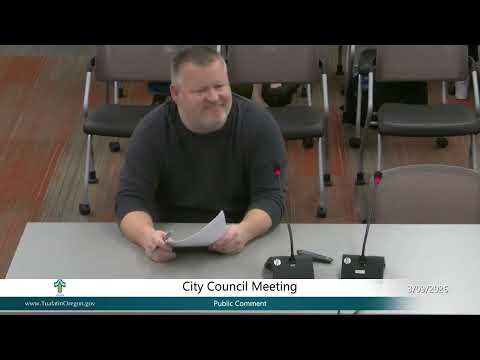
Kevin, a local resident who testified in favor, told the council the changes would correct ambiguity in a 2013 ordinance and allow neighborhood diversity. “These changes make that very clear,” he said, arguing updated rules reflect current resident preferences.
Council members pressed staff on enforcement and public‑health safeguards. The city’s code enforcement representative told the council the city currently has 28 active chicken licenses and that most enforcement to date has been complaint‑driven; staff also said nuisance and debris language in the municipal code would be used to address compost or odor complaints.
Several councilmembers expressed concern about disease risk and practical enforcement capacity. One councilmember asked whether the enforcement officer had the capacity to proactively inspect coops; staff said complaints historically drive much enforcement but that the city has responded to and resolved past complaints.
The council held first and second readings by title only and voted on the proposed ordinances. Because the final adoption vote was not unanimous, councilmembers moved both items to return for additional consideration on March 23.
What’s next: Both ordinance 1454‑26 (development code amendments for domestic fowl; PTA 26‑0001) and companion ordinance 1455‑26 (municipal code Title 6‑15) will be placed on the March 23 agenda for further deliberation and potential adoption. The council directed staff to post clarifying best practices and links to existing nuisance code on the city website to help residents prepare for licensing and compliance.
AI generated
The text on this page is AI generated. Summaries, highlights, analysis, and video transcripts are all produced from the original source material.
AI can make mistakes, so if you spot one, and we will fix it for everyone.
Note: the source content is unaltered by us. Any content source we link to, be it a video, an audio recording, or a document, is presented exactly as its publisher released it. That publisher is usually a government body, sometimes an individual official or another organisation.