Get Full Government Meeting Transcripts, Videos, & Alerts Forever!
Get email alerts on the Data Centers topic
No spam. Unsubscribe anytime.
Georgia Tech pitches 'Grid‑Ready' program as Spalding leaders defend strict data‑center rules
Summary
Georgia Tech presented a Grid‑Ready Communities program to help local governments plan proactively for data centers, emphasizing fiscal modeling, ordinance drafting and community engagement. Several commissioners and residents stressed that Spalding County's ordinance already sets high standards for cooling, water use, noise and setbacks.
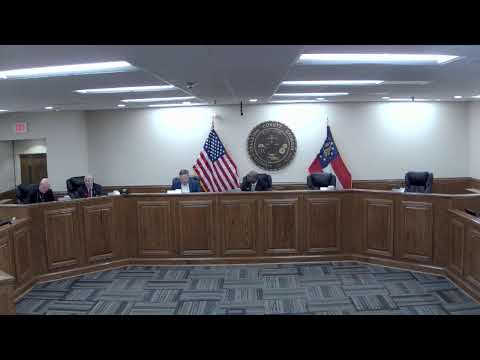
Lee Hopkins of Georgia Tech’s Center for Economic Development Research introduced the Grid‑Ready Communities Program at the May 18 Spalding County meeting, describing a suite of tools to help counties plan for high‑energy users such as data centers. "We want to help communities think through ... and match them with research happening at Georgia Tech," Hopkins said.
Hopkins said the program helps communities move from a defensive posture to proactive planning — including ordinance review, fiscal strategy and public engagement — and can provide model ordinances and technical expertise on cooling, water and noise mitigation.
During questions, county officials and Hopkins discussed Spalding County’s ordinance. Hopkins noted the county’s rules are advanced and then turned technical questions over to the presenters: closed‑loop cooling, heat reuse and ordinance drafting. A county speaker (Dr. Ledbetter and commissioners during Q&A) described local requirements that prohibit open evaporative cooling, limit water use and call for acoustic mitigation. "Our rules require a 20‑ft acoustic dampening wall ... in addition to the 100‑ft setback and 6‑ft berm," one commissioner said, adding the county does not offer tax subsidies to data‑center developers.
Residents later raised concerns during public comment about harmonizing the county and city ordinances, variances and the effects of power lines and water consumption. Presenter Hopkins and commissioners emphasized research‑backed tradeoffs — for example, closed‑loop systems may include internal evaporative steps that keep water internal to the loop — and offered to provide technical resources to answer site‑specific questions.
County leaders repeatedly framed Spalding’s ordinance as a defensible, court‑tested standard. "We're a gold standard," a commissioner said, noting the county's limits and site‑specific conditions have withstood legal scrutiny, while urging continued vigilance on variances and planned‑development loopholes.
What happens next: Georgia Tech offered deeper ordinance comparisons and technical follow‑up; commissioners invited the team to analyze the county’s rules and recommended practices for workforce development, design and environmental safeguards.