Get Full Government Meeting Transcripts, Videos, & Alerts Forever!
Get email alerts on the Oral Language Indicator topic
No spam. Unsubscribe anytime.
Governance committee debates oral-language indicator; agrees to clarify R2 as K–3 and send change to consent agenda
Summary
The Racine Unified School District governance committee reviewed a proposed oral language indicator tied to state Act 20 assessments, debated whether it should apply only to K–3 or to all students, raised concerns about measurement validity and equity for students who speak nonstandard dialects or other home languages, and agreed to add a clarifying K–3 change to the consent agenda.
The Racine Unified School District governance committee on the agenda reviewed proposed interpretations and indicators for reading, writing and a new oral language indicator, debated whether the indicator should apply to all students or be limited to kindergarten through third grade, and agreed to add a clarifying change (K–3) to the consent agenda for the business meeting.
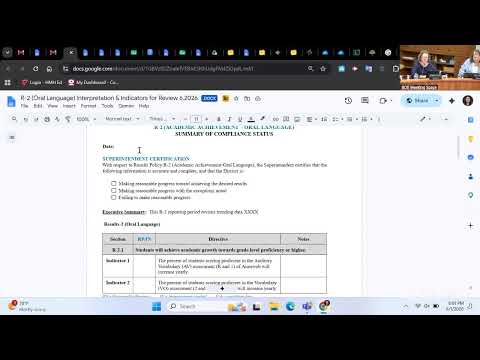
The discussion centered on how oral language should be defined and measured. Presenter (S6), who introduced the new oral-language indicator, told the board the state’s Act 20 requirement ties oral-language assessment to grades K–3 and described two assessment types: an auditory task for younger children and a productive vocabulary measure used in second and third grades. "So I wanna make sure that we are spot on with the brand new 1 of oral language," Presenter (S6) said, explaining the district used the state definition as a starting point because the requirement is clearly specified for early grades.
Board members questioned whether the indicator should cover all students or only those the state requires the district to test. Chair (S3) asked whether the R2 language should be revised to specify K–3 or whether the board should seek a broader classroom-embedded rubric for older students. Committee member (S4), speaking from an English-teacher perspective, argued for measuring oral language across grades to prepare students for secondary expectations, while Presenter (S6) noted that implementing a consistent presentation rubric across classrooms and grades would require substantial training and district-wide mechanics.
Several trustees raised concerns about the validity and fairness of oral-language testing. Committee member (S5) cautioned that "the state does not have a good measurement tool for oral language" and warned that testing oral fluency can penalize students who speak dialects or whose home language is not English: "Districts like ours that have a wealth of diversity, we're gonna get scored down." Presenter (S6) acknowledged those challenges, saying the K–3 AIMSweb/Act 20 approach is limited but offers an identifiable starting point and that some vocabulary strands can be extracted from other reading assessments such as Amira or the forward strands.
Board members discussed practical options for presenting results in the R2 policy. Possibilities included leaving oral language as a distinct K–3 indicator, embedding vocabulary strands under reading so the district could report vocabulary without adding a new district-wide assessment, or creating an ELA category that would include oral presentations and writing. Several members favored keeping the R2 language aligned with the state requirement and exploring mechanics for broader measures in the future.
By the end of the meeting the committee agreed to have staff revise R2 to clarify that the oral-language indicator applies to K–3 (the state requirement) and to place that revision on the consent agenda for the upcoming business meeting. Chair (S3) said the change would be included in the consent agenda and returned to the board for a vote during the business meeting. The committee also approved the governance committee minutes of 05/04/2026 earlier in the session (motion passed, 7–0).
The governance committee will continue its review at the next meeting, starting with the reading indicators. Staff were asked to prepare materials and, if requested by the board, to bring data and examples of how AIMSweb/Amira and other measures report vocabulary and oral-language strands.