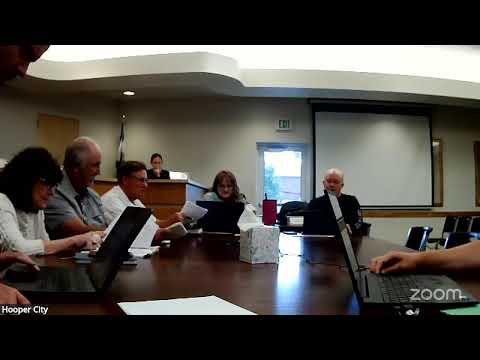
Council debates data-center rules and whether to amend code or impose moratorium
Summary
Council members flagged potential risks from data centers (water and power use, cooling methods) and discussed whether to revise zoning code (define and limit data centers) rather than impose a moratorium; consultants and members cited Provo and Cedar City as precedents.
Council members raised concerns about how data centers might locate in Hooper and whether existing zoning language is sufficient. A council member (S5) said Hooper's code currently prohibits uses not listed in the code but acknowledged that the code "isn't ironclad" against creative reclassification, and suggested explicitly defining "data center" and adding setbacks, operational limits and water/power requirements.
Council members cited nearby cities' actions: Provo had updated its code to define and tightly limit data centers, and Cedar City had imposed a moratorium after a large application appeared. One council member asked whether a temporary moratorium would be advisable while the city rewrites code; a consultant and other members advised code revision rather than a moratorium, saying the planning commission should be able to evaluate applications under clarified language.
Technical concerns surfaced in the discussion: one speaker (S6) cited a projection that AI-related demand could substantially increase national power and water needs over the next decade, and other members suggested limiting cooling technologies (Provo's ban on non-evaporative cooling was mentioned) and considering power-usage limits in the ordinance.
Why it matters: large data centers can bring heavy utility demands and land-use impacts; how the city defines and regulates the use will determine whether small or industrial-scale facilities can locate inside Hooper. The council discussed balancing the legal risks of an outright prohibition with the need to set enforceable, location-specific controls.
Next steps: members said they will discuss code language and potential definitions with planning staff and counsel; no formal moratorium was recommended in the work meeting, but council agreed to pursue code changes to address potential gaps.
AI generated
The text on this page is AI generated. Summaries, highlights, analysis, and video transcripts are all produced from the original source material.
AI can make mistakes, so if you spot one, and we will fix it for everyone.
Note: the source content is unaltered by us. Any content source we link to, be it a video, an audio recording, or a document, is presented exactly as its publisher released it. That publisher is usually a government body, sometimes an individual official or another organisation.