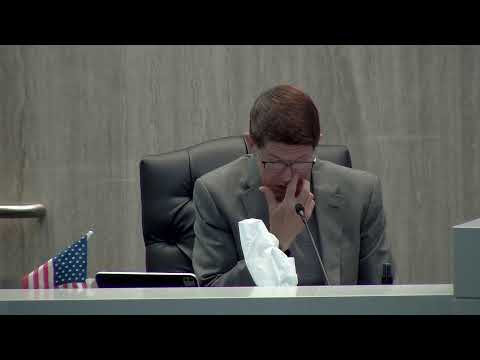
Denton County adopts standalone development fee schedule, raises some permit fees
Summary
On June 2, 2026 the Denton County Commissioners Court unanimously adopted a standalone development services fee schedule that removes fees from subdivision rules, changes how engineering/inspection fees are calculated and raises several permit fees (notably culvert permits from $15 to $300).
Denton County Commissioners Court on June 2 unanimously adopted a standalone development services fee schedule and rescinded the prior court order establishing development permit fees.
The change moves development-related fees out of the subdivision rules and regulations into one centralized schedule and changes how engineering review and inspection fees are set. County staff described the shift as required and prompted by recent changes in state law that prohibit setting those fees as a percentage of construction cost. Instead, staff recommended option 2 from the statute — an hourly/estimated‑time method based on county employee time and actual direct costs. The court approved the recommendation by voice vote.
County staff, represented by Steven Belknap, said the schedule consolidates fees scattered across code sections and court orders and updates fees that haven’t been reassessed for years. ‘‘We dialed in what we believe it costs us in staff time, administrative fees, software fees — what it costs development services to perform these functions,’’ Belknap said during the staff presentation. He noted the last permit fee increase occurred in 2002 for certain permits.
The staff presentation listed several specific changes. The culvert permit fee will increase from $15 to $300, which staff said reflects four site trips and associated inspector time and mileage; a driveway inspection fee is new at $75; the junk/salvage yard fee is $25 as set by state statute; and the county added fees for manufactured-home infrastructure and RV-park infrastructure plan reviews. Staff also said the current engineering review and inspection approach (2% and 3% of construction cost) can produce widely varying bills depending on construction-value inflation, so the hourly approach is fairer and more predictable.
Commissioners debated the size of some increases, with Commissioner Mitchell and others urging sensitivity for individual homeowners who might face a larger sticker shock for small projects. Commissioner Edmondson said she did not want county government to act as a ‘‘profit center’’ and supported the staff rationale that the proposed fees represent county costs rather than revenue generation. Commissioners asked staff to revisit the schedule periodically and recommended a follow-up evaluation after data accumulates.
Belknap provided pro forma comparisons showing some small subdivisions could see increases while larger developments — particularly those with very large construction costs such as municipal utility districts — could see substantial savings under the new formula. The court approved the fee schedule and directed staff to monitor impacts and return with data, with members indicating an intent to reassess fees on a regular multi‑year cadence.
The action rescinds Court Order No. 020494 and places development fees into the new standalone schedule. The court voted to adopt the fee schedule by unanimous voice vote. The county said it will publicize the changes and the rationale for higher inspection-driven fees so applicants understand the steps behind particular permit charges.
What happens next: staff said they will track impacts and suggested a one‑to‑two year review to validate assumptions and make adjustments as needed.
AI generated
The text on this page is AI generated. Summaries, highlights, analysis, and video transcripts are all produced from the original source material.
AI can make mistakes, so if you spot one, and we will fix it for everyone.
Note: the source content is unaltered by us. Any content source we link to, be it a video, an audio recording, or a document, is presented exactly as its publisher released it. That publisher is usually a government body, sometimes an individual official or another organisation.