Officials report steady Lake Whatcom progress, cite deep‑water oxygen and internal phosphorus concerns
Summary
City, county and district staff highlighted 2025 progress—new AIS rapid‑response plan, $11 million in land acquisitions and a joint forest management plan—while scientists warned dissolved oxygen at depth remains low and internal phosphorus loading is a continuing driver of lake risk.
City and county officials on Wednesday presented a condensed 2025 Lake Whatcom progress report and outlined priorities for 2026, while a university scientist flagged persistent deep‑water oxygen depletion and internal phosphorus release that will complicate recovery efforts.
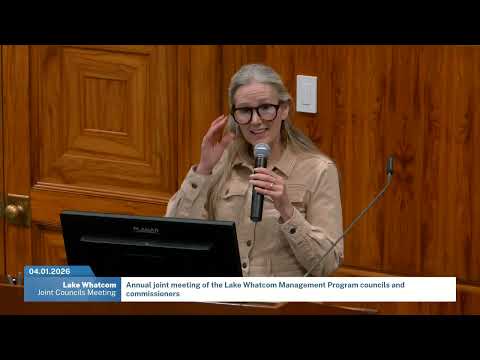
"Everything below 2 milligrams per liter is really limiting for aquatic life," said Dr. Angela Strecker, director of the Institute for Watershed Studies at Western Washington University, summing up long‑term monitoring trends for dissolved oxygen at depth. Strecker told the joint meeting of Bellingham City Council, Whatcom County Council and Lake Whatcom Water and Sewer District commissioners that oxygen has declined most dramatically in Basin 1 and that phosphorus concentrations in bottom waters are two to three times higher than surface values, a phenomenon known as internal loading.
County Executive Paul Sidhu and Bellingham Mayor Kim Lund described shared investments and management coordination that staff say produced measurable outcomes last year. Jason Porter, the city’s surface and stormwater manager, highlighted three 2025 accomplishments the staff presentation emphasized: adoption of a Lake Whatcom invasive freshwater mussel rapid‑response plan and expanded AIS monitoring, a land‑acquisition program that purchased 16 properties totaling 1,056 acres (including a 754‑acre tract), and a joint forest management plan covering more than 13,000 acres of city and county forest lands.
"We are now generating an additional $65,000 in revenue" from updated AIS permit fees, Porter said, a change intended to help sustain inspection and early‑detection work.
Whatcom County natural resources manager Gary Stoyka described the Lake Whatcom model the agencies submitted to the Washington State Department of Ecology and said Ecology has begun a reassessment that could inform long‑term targets. Stoyka cautioned the reassessment is a multi‑step technical review and said staff do not expect immediate changes to the current five‑year work plan while Ecology conducts its review.
Staff also listed 2026 operational priorities including stormwater capital projects in Bellingham and county neighborhoods, design of additional treatment systems, harmonizing city and county development regulations, and a climate vulnerability assessment scheduled to run about 18 months.
The presentation and discussion repeatedly emphasized the long horizon for lake recovery. "This is going to take time," Sidhu said, noting the TMDL framework uses a multidecade time frame. The meeting closed with an invitation to engage at upcoming Lake Whatcom Policy Group meetings, and members of the public urged faster action and clearer metrics during the public comment period.
The joint bodies did not take formal votes on new regulations at the meeting; staff were asked to return with more detailed proposals and to continue interjurisdictional work on code changes and program implementation.
AI generated
The text on this page is AI generated. Summaries, highlights, analysis, and video transcripts are all produced from the original source material.
AI can make mistakes, so if you spot one, and we will fix it for everyone.
Note: the source content is unaltered by us. Any content source we link to, be it a video, an audio recording, or a document, is presented exactly as its publisher released it. That publisher is usually a government body, sometimes an individual official or another organisation.