Get Full Government Meeting Transcripts, Videos, & Alerts Forever!
Get email alerts on the Bridge Replacement topic
No spam. Unsubscribe anytime.
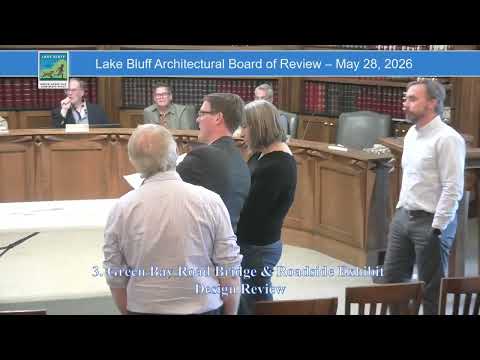
Lake Bluff review narrows bridge design: vertical railing preferred, roadside exhibit planned
Summary
The Lake Bluff Board of Architecture Review recommended a vertical picket-style railing and a modest roadside exhibit for the Green Bay Road bridge replacement after engineers said the original 19th-century truss is embedded in concrete and cannot be reused structurally. The board asked staff to refine sketches and return for approval.
Lake Bluff — The village’s Board of Architecture Review moved Monday to prioritize a vertical railing and a modest off-bridge exhibit as the team advances plans to replace the Green Bay Road bridge that crosses the railroad.
Board members and staff acknowledged a key constraint from the outset: the railroad’s 140-foot corridor requires a 10-foot-high protective fence over the tracks and the State Historic Preservation Office and Federal Highway Administration want a roadside exhibit that incorporates members of the existing bridge or uses those members in an approved nearby display. "They are requiring a roadside exhibit," a village staff presenter said during the meeting, adding the exhibit must be physical truss members or a comparable interpretation rather than just photographs.
The meeting featured sustained debate over whether to salvage and reintegrate original truss pieces or to create new, interpretive elements. "I did a bunch of research ... it is pretty historic," board member Sue said, summarizing archival work that traced the structure to the late 19th century and described its double-Warren truss form. But engineering staff warned that much of the old truss was embedded in concrete during a 1988 rehabilitation and that removing that concrete risks destroying the members. "We really can't save it the way it is right now," the village engineer said, describing riveted gusset plates and unknown steel alloys that make welding and field reconstruction uncertain.
Because of those technical limits and the project’s safety requirements, the board coalesced around a compromise: build a 42-inch stone-or-concrete pedestrian/vehicle crash barrier across most of the span, then attach a crash-tested vertical metal fence where the 10-foot height is required over the railroad. That approach keeps the rail line "open" to pedestrians visually while meeting the railroad and crashworthiness standards, members said. "I vote vertical," one board member said in summarizing the group preference for the vertical picket treatment over an open mesh grid, which several residents called "cage-like."
On how to honor the historic truss, members favored salvaging usable pieces for an interpretive roadside exhibit placed off the bridge — likely on or near the Northshore bike path where pedestrians can read explanatory signage and interact with the display — rather than forcing truss elements back onto the active bridge where structural, ADA and crash-safety rules would require risky modifications. Several board members suggested a simple pedestal or small shelter with a plaque and limited landscaping that would meet SHPO and FHWA criteria without obstructing sight lines at the busy Green Bay/176 intersection.
The board also discussed design details that staff will refine: end piers or "posts" that tie the stone wall to the vertical fence, modest decorative lighting at the bridge approaches (board members favored low, downward-facing fixtures to avoid glare), and whether to use powder-coated or sand-blasted finishes on salvaged pieces. Staff reiterated that FHWA and SHPO sign-off on the roadside exhibit is on the project's critical path and must be included in the construction plan sets for funding and permit approval.
Next steps: staff will return with refined sketches showing (1) the stone/short-wall plus vertical-fence treatment for the 10-foot railroad span, (2) a proposed location and concept for a modest roadside exhibit (staff favored a bike-path setting and noted two candidate corners near Green Bay/176), and (3) details on how salvaged members could be preserved, stabilized and displayed without compromising safety. The board will review those drawings at a forthcoming meeting and then forward its recommendation to the village board for final action.
The meeting concluded with a motion to adjourn after the sketching assignments were made.