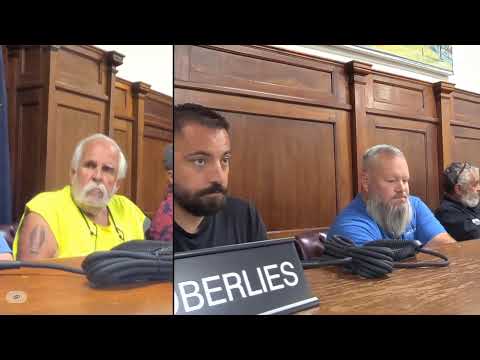
Plan commission backs changing parcel-split rule, sends revision to county commissioners
Summary
The Scott County Area Plan Commission voted to forward a revision to the subdivision-control ordinance that would limit a parcel to four splits within a two-year period measured from the last split; the change applies to county parcels and excludes city property and will be sent to the county commissioners for final action.
The Scott County Area Plan Commission voted June 10 to forward a proposed revision to the county’s subdivision-control ordinance that would allow up to four splits of a parent tract within a two-year period measured from the last split, rather than permitting unlimited splits over any period.
The change — which commission members framed as a way to prevent continual fragmentation while preserving landowners’ ability to divide property — will be sent to the county commissioners with the plan commission’s recommendation.
Randy Julian, a commissioner who moved the revision, summarized the change for the commission: “A revision of the parcel split rule to say that any parcel that is in county area, not to include any city … would be moved to 4 splits of that parcel in a 2 year period,” and asked for a second. Staff and other members discussed how the rule would be measured and enforced, with repeated emphasis that the two-year clock should run from the last split.
Staff clarified that the language affected the subdivision-control ordinance’s paragraph (d), which currently reads that divisions must not result in more than four lots being divided from a single parent tract “over any period of time.” A staff member noted the intent of the revision: “So we would be changing paragraph d … to say instead … 2 years,” and urged precise wording so the commission and the public can track compliance.
Members debated practical issues the change raises, including how the limit interacts with minor and major subdivision rules, who logs splits and when a parcel becomes a subdivision, drainage control and access easements, and whether landowners could ‘game’ the timing by waiting out the two-year period. One member said tracking should be tied to the last recorded split: “Once you use the last split, it’s 2 years from then.”
After discussion, the commission voted by roll call to approve the wording as recommended and forward it to the county commissioners. The roll-call recorded members voting yes: Gary Green; Mark Gardner; John Houser; Jonathan White; JR Ward; Andrew Boswell; Randy Julian; and Matt Wallees. One member was absent. The commission indicated staff will refine the exact language and submit it to the commissioners for final consideration.
The commission noted that if unforeseen problems arise after the change is adopted, the ordinance can be revisited and amended. The plan commission’s action is a recommendation; final adoption would rest with the county commissioners.
What happens next: Staff will work with the chair to finalize the precise ordinance text and transmit it to the county commissioners for their review and potential adoption.
AI generated
The text on this page is AI generated. Summaries, highlights, analysis, and video transcripts are all produced from the original source material.
AI can make mistakes, so if you spot one, and we will fix it for everyone.
Note: the source content is unaltered by us. Any content source we link to, be it a video, an audio recording, or a document, is presented exactly as its publisher released it. That publisher is usually a government body, sometimes an individual official or another organisation.